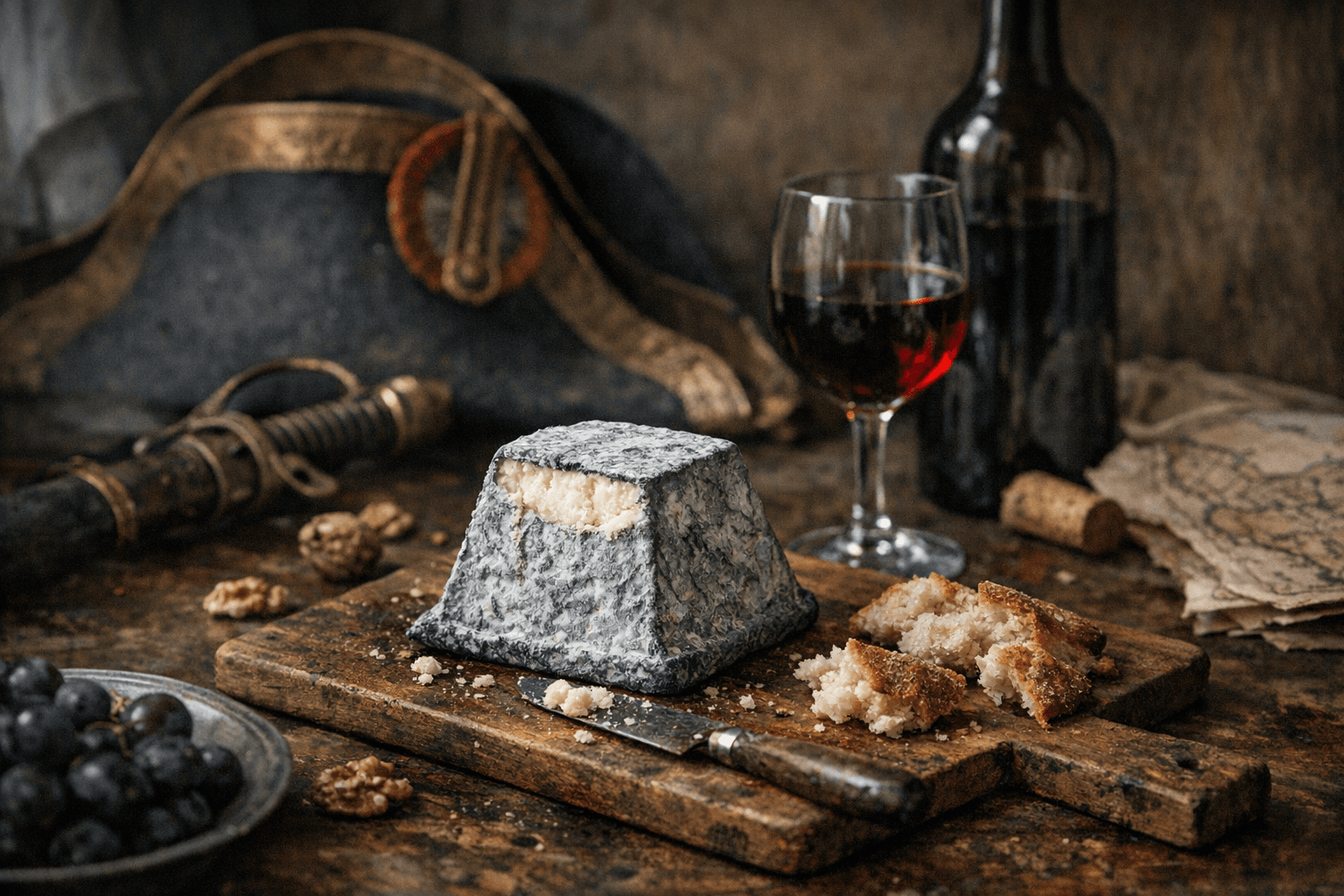
Valençay is a French AOP goat cheese from the Berry region with a distinctive flat-topped pyramid shape and a legend involving Napoleon, a sword, and a very bad mood about Egypt. One of those things is verifiable.
There is a French goat cheese called Valençay that is shaped like a pyramid with the top cut off. The story of why the top is cut off involves Napoleon Bonaparte returning from his Egyptian campaign in 1798, arriving at the Château de Valençay — which his foreign minister Talleyrand purchased in May 1803 — seeing a pyramid-shaped cheese on the table, and drawing his sword to slice off the point in a fit of rage over his military losses. This is, by most food-history accounts, a legend. It is also a very good legend, which is probably why 24 farmhouse producers in central France are still selling 298 tons of it per year under AOP protection without feeling any pressure to correct the record.
What the Legend Actually Says, Depending on Who Is Telling It
The Napoleon story has at least two versions, which is usually a sign that something is more folklore than biography. In one version, Napoleon himself draws the sword. In the other, Talleyrand — anticipating that a full pyramid of cheese might remind his guest of the campaign that did not go especially well — cuts the top off himself before Napoleon can see it. Both versions agree that Egypt is the problem and that the cheese suffers for it.
Sources including Connexion France, Culture Cheese Magazine, and Taste of France Magazine all repeat the story and all flag it as legend, myth, or, in one case, 'most probably just legends.' The more grounded explanation, noted by Connexion France, is that the truncated shape likely developed for logistical reasons — a full pyramid point is fragile, difficult to age evenly, and prone to breaking during transport. France, it turns out, has occasionally made practical decisions about cheese.
What the AOP Actually Confirms
What is not a legend is Valençay's AOP status, overseen by the Institut National de l'Origine et de la Qualité (INAO), the French body that administers protected designations. The cheese is produced in the Berry region, specifically the Indre department of central France. It is made from raw goat's milk, aged with a coating of ash and natural molds that give it a blue-grey rind, and shaped — always — into that flat-topped truncated pyramid. According to the Produits Laitiers AOP registry, 298 tons were marketed in 2020 across 24 farmhouse producers. That is the verifiable part.
The flavor profile of a properly aged Valençay runs from fresh and lactic at three weeks to earthier, nuttier, and more assertive at six weeks or beyond. The rind has a dry, chalky texture. The paste underneath is dense and bright white. It does not taste like a cheese that needs a legend to justify its existence, but the legend has not hurt.
What to Drink With a Cheese Napoleon May or May Not Have Decapitated
The Loire Valley sits close enough to the Berry region that pairing Valençay with a Sancerre or a Pouilly-Fumé is not creative — it is just geography. The high-acid, mineral-driven Sauvignon Blanc from those appellations cuts through the fat of the goat's milk and picks up the chalky, herbal quality of the rind without competing with it. A Menetou-Salon, which is less discussed and costs less, does the same work. If you want to stay in the region and go red, a Pinot Noir from nearby Reuilly will work, though the conventional wisdom — and in this case conventional wisdom is correct — is that fresh goat cheese and crisp white wine is a natural agreement that predates the legend by several centuries.
The wine, the cheese, and the story all come from the same stretch of central France. Whether Napoleon took a sword to one of them is beside the point.
Valençay is worth knowing because it is an excellent AOP goat cheese from central France with a specific production zone, a recognized shape, and a flavor that improves with age. The Napoleon story is worth knowing because it is the kind of thing that happens when a cheese becomes famous enough that someone feels compelled to give it a dramatic origin. The truncated pyramid probably exists because a full pyramid breaks in transit. But 'the top was sliced off to spare a general's feelings about Egypt' is a better sentence, and the French have always understood that the story you tell about a cheese is part of the cheese.
* This article contains opinions, satire, and possibly correct information about wine and cheese. It is not medical advice.