A dispatch from the Burgundian cheese puff rabbit hole — where choux pastry meets Gruyère, wine cellars become tasting rooms, and no one leaves with fewer than three batches in the freezer.
There is a category of food that operates less like a recipe and more like a subscription you never consciously signed up for. Gougères — the small, hollow, Gruyère-laced choux puffs from Burgundy — belong to this category. You make them once, ostensibly for a dinner party or because you have a block of Comté aging in your cheese drawer, and then approximately six weeks later you are buying a third sheet pan because the first two are already in the oven. This is not a personality flaw. This is, according to the clinically unverified field research conducted at this publication, the expected and irreversible outcome.
A Burgundian Prescription Dating to the 1600s
Gougères come from Burgundy — specifically, most food historians point to the town of Tonnerre in the Yonne department, though the exact baker responsible has wisely remained anonymous, presumably because they understood what they were unleashing. The timeline is contested in the way that only French culinary history can be contested, with various sources nominating the 16th century, the 18th century, or Pierre Lacam's 1865 Le Nouveau Pâtissier-Glacier Français as the moment the recipe entered the official record. What everyone agrees on is that they originated as a domestic dish — something made in Burgundian households and, more relevantly, in the cellars where the region's wine was being poured for tasting.
That last detail matters. In Burgundy, gougères are traditionally served cold at wine tastings, passed around the cellar while someone draws Pinot Noir directly from a barrel. The salty, eggy, cheese-forward puff does not compete with the wine. It clarifies it. The fat from the butter and Gruyère cuts through the richness of a white Burgundy Chardonnay; the salt pulls the earthiness out of a Nuits-Saint-Georges Pinot Noir. This is not accidental pairing wisdom. This is four hundred years of empirical evidence accumulated by people who had very good reasons to keep their tasting guests comfortable and slightly distracted.
The Mechanics of Irreversibility
Gougères are made from pâte à choux — the same base dough that produces éclairs and profiteroles — which means you are starting with a preparation that is already structurally designed to make you feel competent. You cook butter and water together, beat in flour, add eggs one at a time until the dough reaches a consistency that pastry books describe as "ribbon-like" and that you will describe as "I think this is right," and then fold in a generous quantity of grated cheese. Gruyère is traditional. Comté, which comes from the neighboring Franche-Comté region and carries a nuttier, more assertive character, is arguably better. Using Swiss Gruyère instead of French Comté is a distinction that will be invisible to your guests and quietly significant to exactly one Burgundian grandmother.
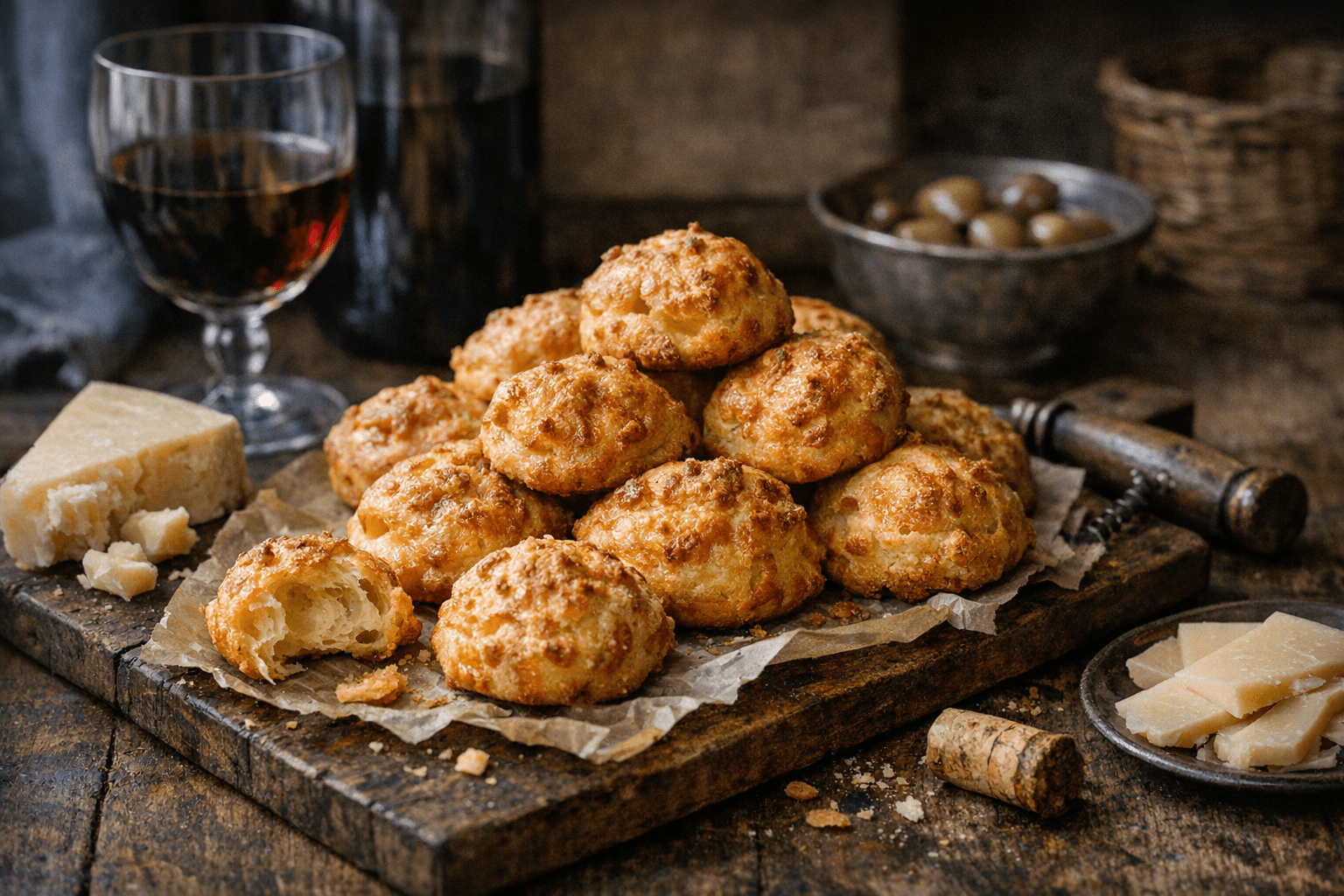
The puffs go into a hot oven and emerge golden, hollow, smelling of toasted cheese and browned butter, and structurally incapable of lasting more than twelve minutes on a serving platter. The Larousse Gastronomique defines them as a staple of domestic cuisine. What Larousse does not mention is that the batch size in every credible recipe produces approximately forty puffs, which is always described as "serving eight to ten" and always, in practice, serves three people who are not paying attention. This is the loop. You make forty. They disappear. You now need to make forty more because you have guests coming Saturday and also because the choux dough is genuinely not difficult and the Comté was on sale.
What the Protocol Actually Requires
The Wine and Cheese Diet ℞ for gougères is as follows. Make them once with Gruyère to understand the baseline. Make them a second time with Comté and a pinch of cayenne, which is the version you will tell people is your recipe. Add nutmeg if you want to feel like you know something extra. Serve them warm from the oven alongside a glass of white Burgundy — a village-level Chardonnay from Puligny-Montrachet is the regional pairing, though any good Chardonnay with enough acid and restraint will behave correctly. Freeze a dozen unbaked before they go in the oven, because the frozen dough mounds bake from frozen with a nearly identical result, and having a supply of frozen gougères is the kind of emergency preparedness that makes a person genuinely prepared for emergencies.
The caloric math on a gougère lands somewhere between 56 and 100 calories per puff depending on size and cheese quantity — a figure the $72 billion wellness industry would prefer you contemplate before eating and that you should, by all means, contemplate after. They contain butter, eggs, and cheese. This is not a coincidence. These are the ingredients that have sustained French regional cuisine for centuries without requiring a single branded protein supplement or a fourteen-day reset.
The gougère does not promise transformation. It does not ask you to track anything. It is a small, warm, cheese-filled puff that has been served in Burgundian wine cellars for the better part of four hundred years, and its continued existence is the most convincing argument available that some things in the food world arrived correct the first time. Make them once. Serve them with Burgundy Pinot Noir. Understand immediately why you will be making them again. The self-sustaining production cycle is not a bug. It is the entire point.
* This article contains opinions, satire, and possibly correct information about wine and cheese. It is not medical advice.