A warm-weather cheese board is not a set-it-and-forget-it proposition. It is a living document, subject to revision every ninety minutes and the ambient temperature of your patio.
Somewhere between May and August, a certain kind of optimism takes hold. The host — let us call them well-intentioned — arranges a cheese board of considerable ambition: three soft cheeses, two bloomy rinds, a generous log of chèvre, stone fruit fanned with architectural precision, and a rosé chosen primarily for the color of its label. Then they set it on a table in direct sun, pour themselves a glass, and return forty-five minutes later to find that the board has become something between a cheese plate and a warm dairy puddle. This guide is for that host. More specifically, it is a clinically unverified but empirically sound framework for building a warm-weather cheese board that survives contact with actual warm weather.
The Four-Position Board Architecture
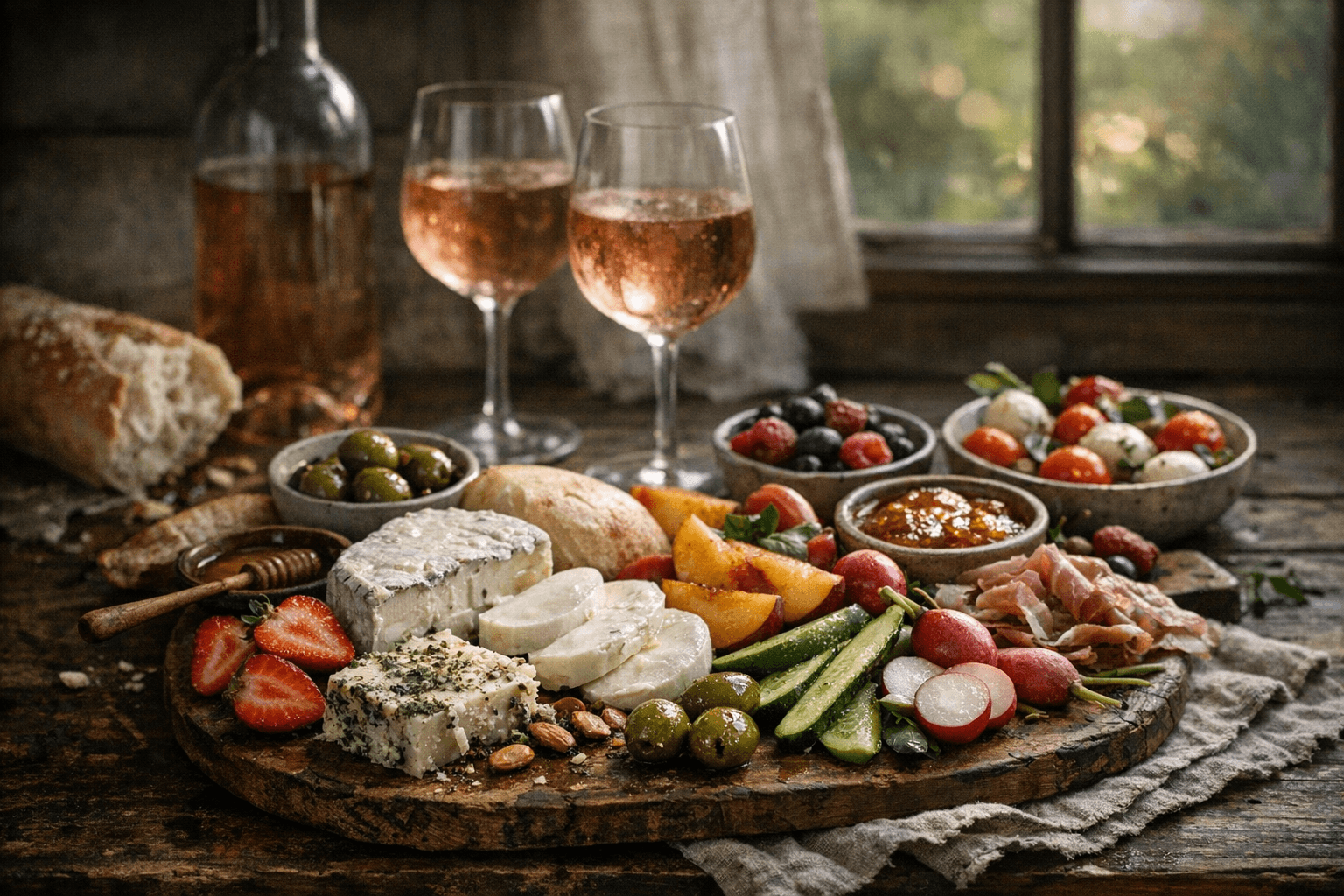
The standard summer board is not an opportunity to display every perishable dairy product you own simultaneously. The Protocol recommends a four-position structure: one fresh cheese (chèvre, feta, fresh mozzarella), one creamy or semi-soft anchor (young gouda, havarti, a young sheep's milk), one firm aged cheese that can tolerate a degree of ambient neglect (manchego, aged cheddar, pecorino), and one salty or crumbly element that provides contrast without requiring refrigeration heroics (a good parmesan, a dry aged feta). This gives you textural range and, crucially, a board that does not collapse structurally the moment it leaves air conditioning.
The accompaniments are where summer asserts itself most usefully. Ripe berries, halved figs, stone fruit slices, cucumber rounds, snap peas, radishes, fresh basil, and mint all belong here. Cornichons. A small pot of honey. Thin crisp crackers that will not turn architectural in humidity. Keep the cut produce cold until the moment of service. This is not fussiness — it is the difference between a board that looks intentional at the two-hour mark and one that looks like an abstract painting of its former self.
The Two-Hour Window and How to Use It Responsibly
The USDA identifies 40°F to 140°F as the temperature range in which bacteria multiply with genuine enthusiasm. Perishable foods should not remain unrefrigerated for more than two hours in ordinary conditions — and that window contracts to one hour when outdoor temperatures exceed 90°F. At 85°F, which describes a pleasant summer afternoon in most of North America, the two-hour rule technically still applies, but a board sitting in direct sun on a dark wood table near a grill is not experiencing 85°F. It is experiencing considerably more, and the cheese is not consulting a thermometer before deciding to soften.
The field-tested correction for this is elegant in its simplicity: do not put out the whole board at once. Designate a cooler or refrigerator as the board's backstage. Set out modest portions of the fresh and semi-soft cheeses. Replenish from cold storage as portions are consumed. The aged anchors — the manchego, the pecorino, the firm cheddar — can hold their position longer without incident. The chèvre cannot. Treat them accordingly. This approach also creates a mild but genuine hospitality theater: the host who refreshes the board from the kitchen appears organized rather than overwhelmed, which is a useful distinction.
On Rosé: A Pairing, Not a Season
A word on the wine, because it will come up. Rosé has become, in certain circles, less a category of wine than a meteorological event — something that simply happens when temperatures rise, requiring no further justification. Researchers studying wine and cheese perception have found that rosé does interact meaningfully with specific cheeses, altering the perceived duration of aromatic and salty notes. It shortened the sensory evaluation time for Chaource in one study. This is interesting and worth knowing. It does not mean that a Provence rosé pairs equally well with every cheese on your board by virtue of being pink and chilled.
For a summer board built around fresh and semi-soft cheeses, a dry rosé with good acidity — Provence, Tavel, something from Navarra — works because it does not compete with the delicate fat and salt of chèvre or young gouda. It also pairs reasonably well with the fruit and herb accompaniments, which is a more useful claim than the one printed on most rosé marketing materials. If you want to explore what a well-made Provence rosé actually does alongside a range of soft and semi-soft cheeses, the category rewards the investment.
The summer cheese board, done correctly, is a study in strategic restraint. The shade is part of the presentation. The cooler beside the table is equipment, not an admission of defeat. The manchego can anchor the board through the second glass; the chèvre cannot be asked to do the same. Build for the temperature you have, not the temperature that would make the board easier. And when the afternoon light goes golden and the board has been replenished twice and the rosé is almost gone, you will find that the food-safe approach and the aesthetically satisfying approach were, in this case, the same approach all along.
* This article contains opinions, satire, and possibly correct information about wine and cheese. It is not medical advice.