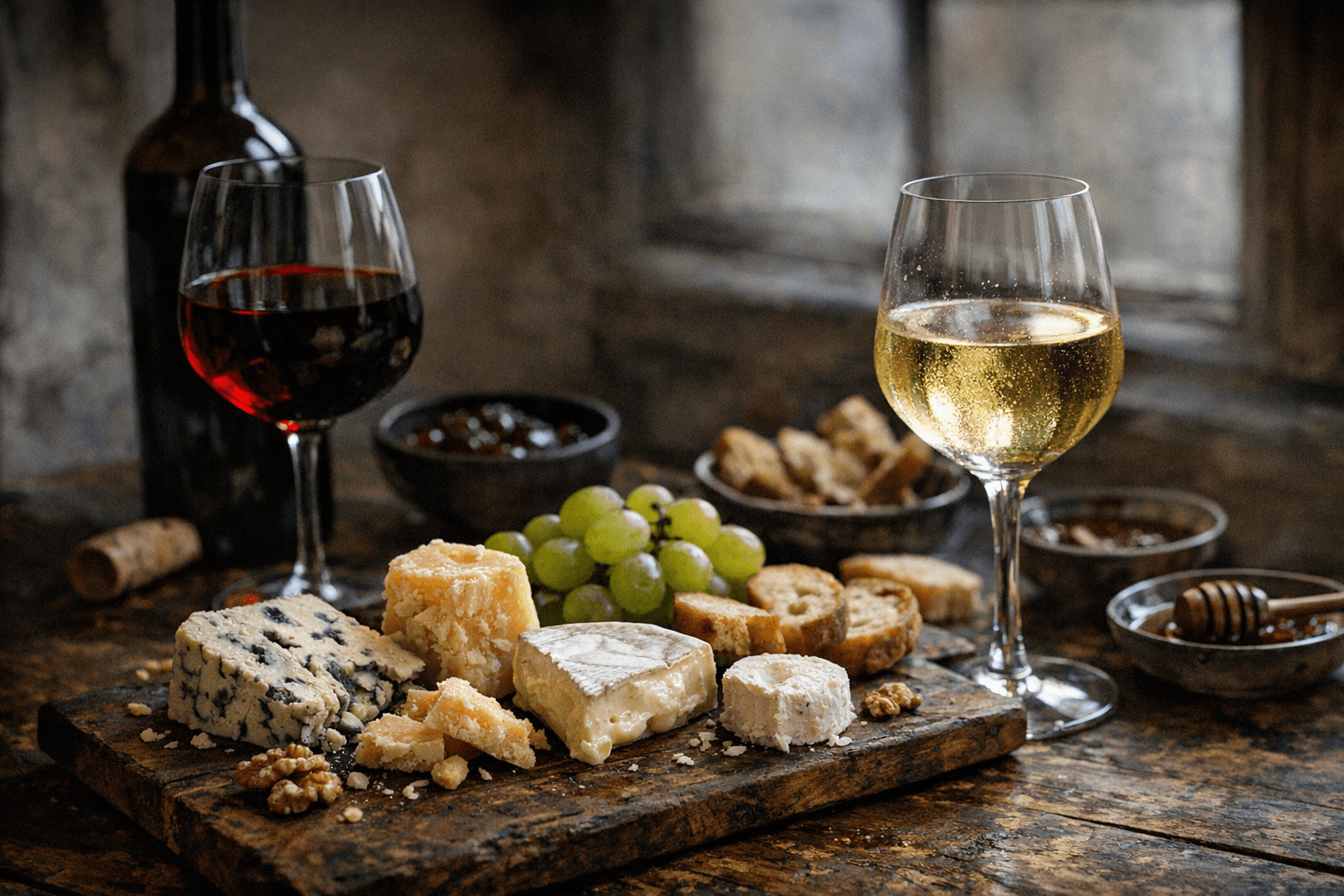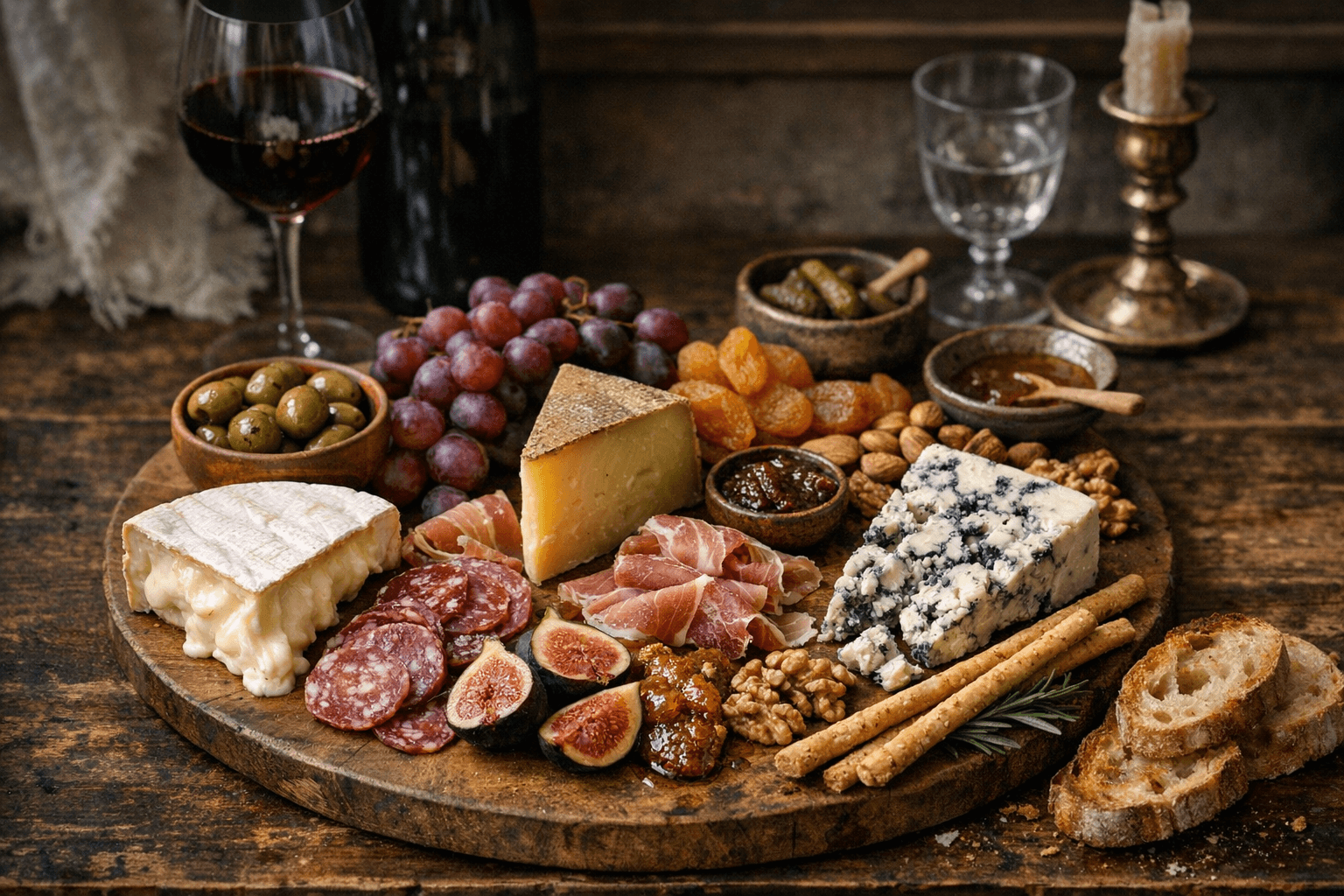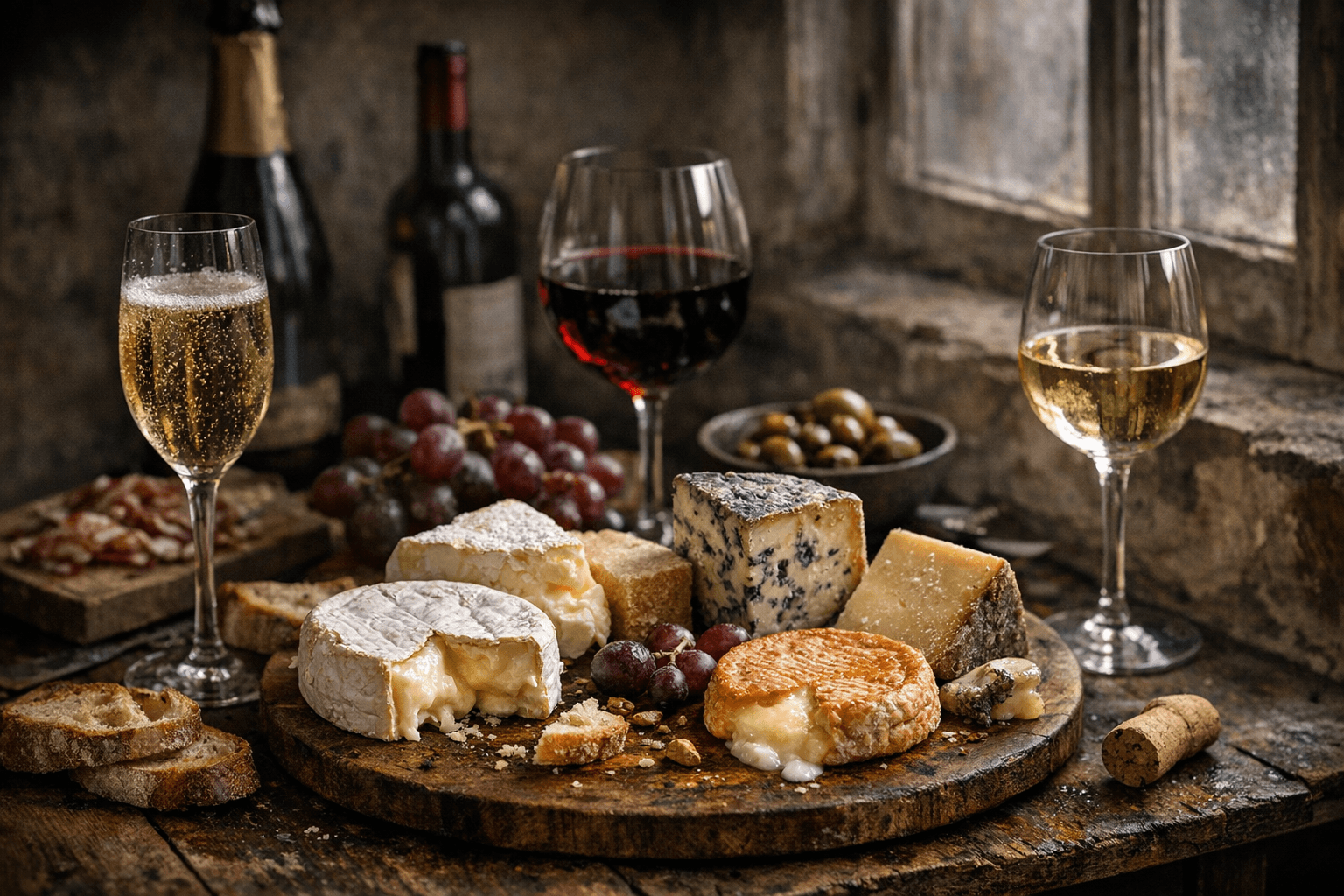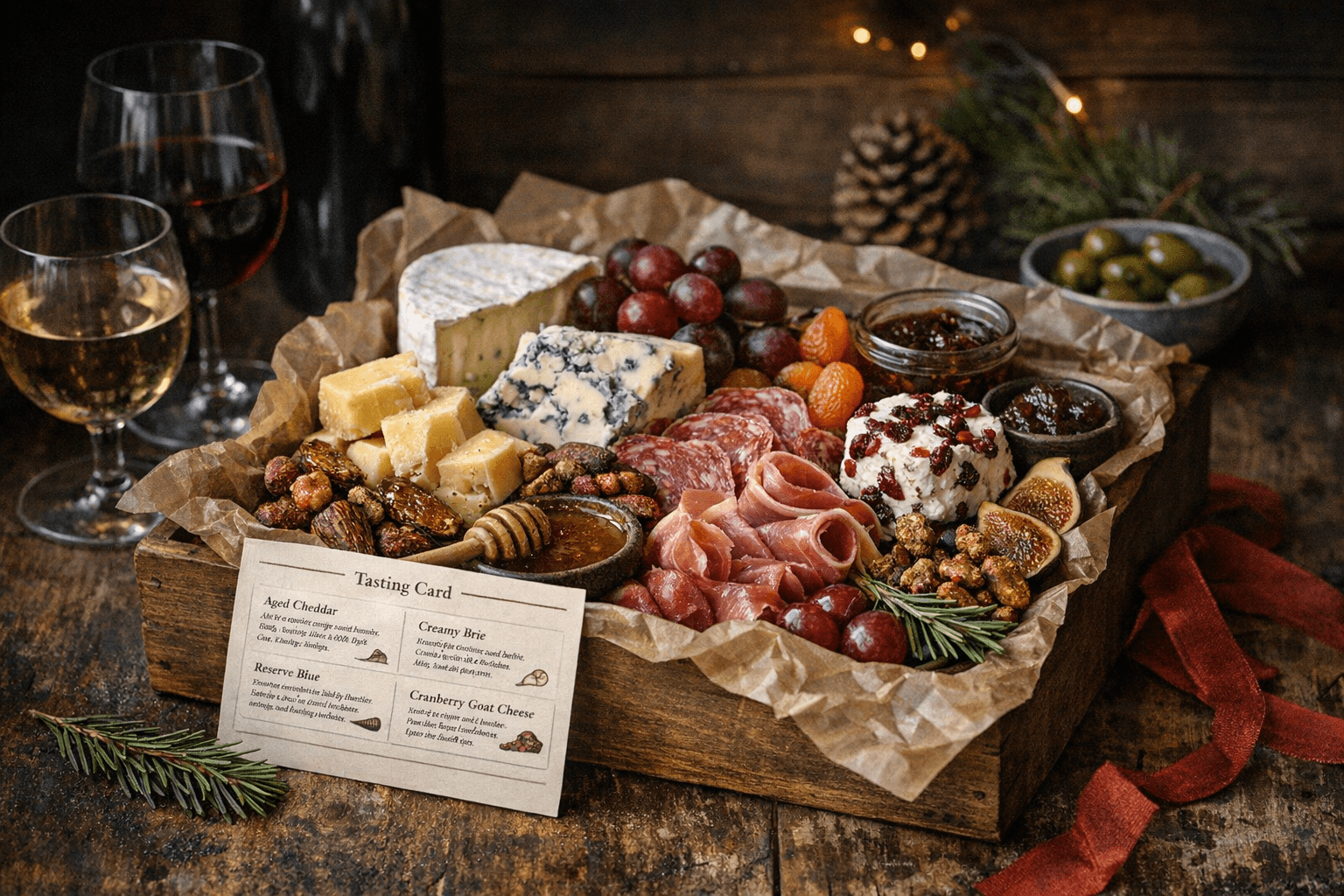
A gift card says you thought about someone for thirty seconds. A three-cheese board with a printed tasting card and region-matched wine says you thought about them for at least forty-five minutes, which is the right amount.
There is a moment at every holiday gathering where someone hands the host a gift card in an envelope and the host says thank you in the exact tone of voice that means they will use it to buy paper towels in February. You do not have to be that person. For roughly the same budget — call it forty to sixty dollars depending on how seriously you take cheese — you can arrive with a fully assembled, regionally sourced cheese board, a small printed tasting card, and a bottle of something well-matched. Nobody forgets the person who brought the cheese board. The gift card person, statistically, is forgotten by dessert.
Three Cheeses Is Sophistication. Seven Is a Cry for Help.
The architecture of a good gift board is not complicated, but the number of cheeses matters more than most people think. Three is the correct number. It gives you range without chaos. The framework that works every time is: one anchor hard cheese, one soft or creamy cheese, and one conversation-starter — something washed-rind, aged and funky, or lightly blue — that makes at least one person at the table say 'I didn't think I liked that kind of cheese.'
For a holiday board with European sourcing, which is both appropriate and easy to justify, the regional trio does the work for you. A wedge of Manchego Curado from Castilla-La Mancha in Spain — made from Manchega sheep's milk, pressed and aged a minimum of three months — is your anchor. It's firm, nutty, and approachable enough that it doesn't frighten anyone. Your soft cheese should be a Brie de Meaux from the Seine-et-Marne region of France, made from raw cow's milk and still carrying its AOC designation from 1980. It is the cheese that does the most convincing on its own. Your conversation-starter is Taleggio DOP from Lombardy, Italy — a washed-rind cow's milk cheese with a pink-orange rind and a surprisingly mild, milky interior that smells more alarming than it tastes, which is most of the fun.
What Goes Around the Cheese Is Also the Gift
A cheese board without supporting elements is just a plate of cheese, which is fine but not memorable as a gift. The intentional board has three supporting categories: something sweet, something salty, and something crunchy. Marcona almonds handle salty and crunchy simultaneously, which is efficient. A small jar of quince paste — membrillo, specifically, which is already a natural companion to Manchego in its home region — handles sweet. Add a handful of dried Medjool dates and a few slices of a good fig-and-walnut loaf, and the board now has texture, color, and a narrative that says 'this was assembled on purpose.'
On the sourcing side, France, Italy, and Spain are the three largest cheese-producing countries in the European Union. France produced approximately 1.92 million tonnes in 2024 according to Eurostat data, Italy 1.36 million tonnes, and Spain 0.54 million tonnes. This matters for one reason: the supply chains for their flagship cheeses are reliable, the quality benchmarks are protected by denomination of origin rules, and you can find Brie de Meaux, Manchego, and Taleggio at a well-stocked specialty grocer without having to call ahead. You are not sourcing a unicorn. You are sourcing a very respectable triangle.
The Printed Tasting Card Is the Thing That Makes You Look Like You Did This on Purpose
Print a simple card — a half-sheet of cardstock, nothing elaborate — with three rows, one per cheese. For each cheese, include the name, the region and country, the milk type, the rind classification, and one pairing note. The pairing note is where the wine enters. For the Brie de Meaux, the pairing is a Champagne Blanc de Blancs, preferably from a grower-producer like Dehours et Fils in the Marne Valley — the acidity cuts through the cream and neither party has to compromise. For the Manchego Curado, a Tempranillo from Ribera del Duero, such as Bodegas Emilio Moro's Finca Resalso, matches the sheep's milk fat with enough fruit and structure to stay interesting. For the Taleggio, a Moscato d'Asti from the Piedmont producer Vietti rounds out the board's funkier edge with something lightly sweet and low-alcohol, which is a kindness to everyone at that point in the evening.
The tasting card is not pretentious. It is the opposite of pretentious. It takes information that already exists — origin, milk, rind, pairing — and puts it somewhere people can read it without having to ask you to explain yourself repeatedly while you're trying to enjoy the party. It also means the host keeps the card after you leave, which is how you become a recurring reference point in someone else's life.
You can spend the same forty dollars on a gift card that will purchase paper towels, or you can spend it on a Manchego, a Brie de Meaux, a wedge of Taleggio, a bag of Marcona almonds, a jar of membrillo, and a printed card that tells people exactly what they're eating and why it goes together. One of these options requires about forty-five minutes of your time and a brief visit to a cheese counter. The other requires you to stand in a checkout line and pick a dollar amount. Both say 'I was thinking of you.' Only one of them is actually interesting.
* This article contains opinions, satire, and possibly correct information about wine and cheese. It is not medical advice.