A whole wheel of Époisses AOP, a warm oven, and about twenty minutes stand between you and the most dramatic cheese course in the French repertoire. The cheese did most of the work already — in Burgundy, over a month ago.
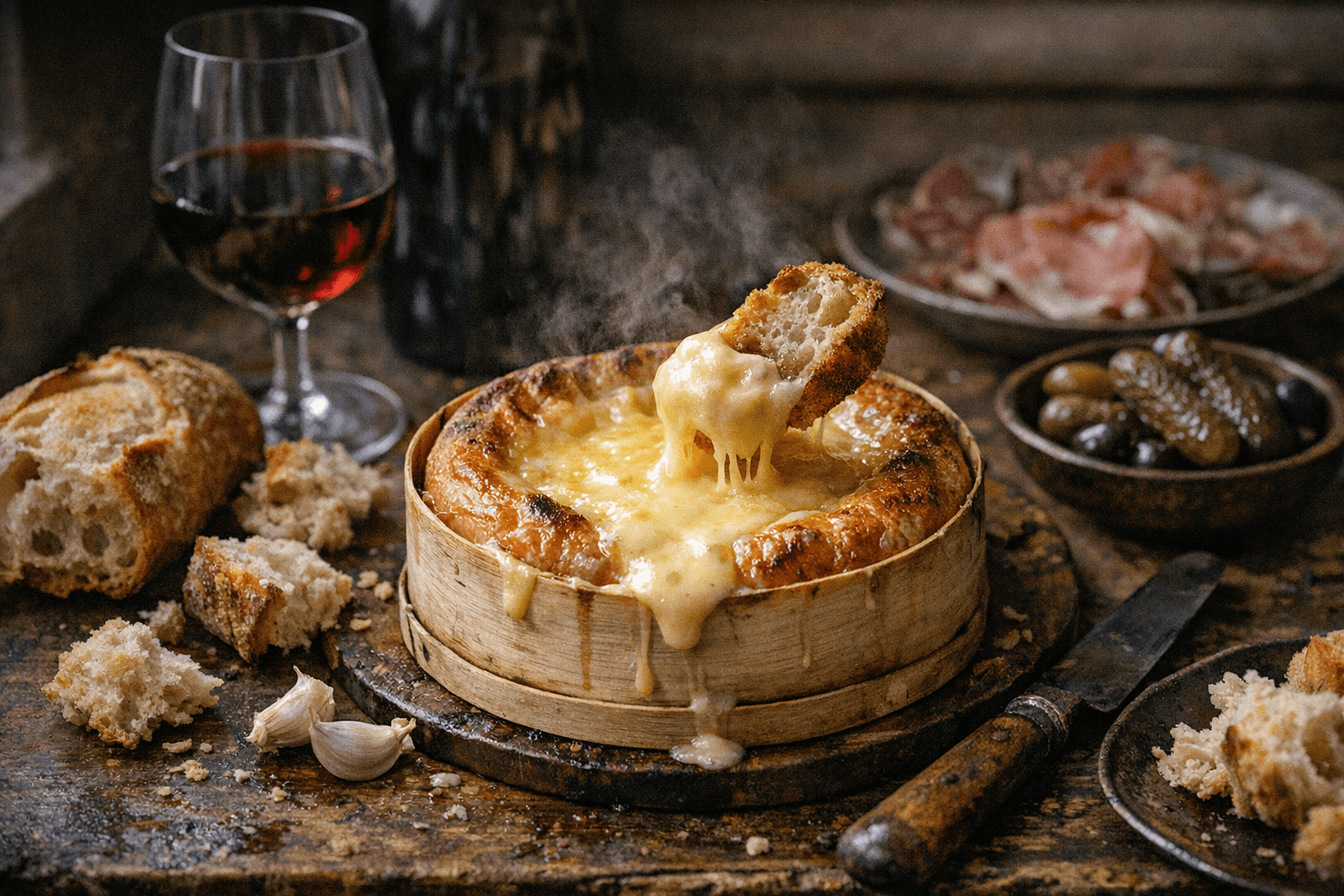
There is a wheel of cheese sitting in your oven right now — or there should be. It is a 300-gram round of Époisses AOP from the Auxois area of Côte-d'Or, Burgundy, produced under a protected designation of origin that has been in place since 1996. Fromagerie Berthaut makes a widely available one. The rind is orange-red, the paste is soft and yielding, and the smell is strong enough that some French trains have reportedly banned it from passenger carriages. In about fifteen to twenty minutes, it will be fully molten in the center, and you will drag a piece of toasted country bread through it and feel like you planned this all along. You did not need a fondue pot. You needed an oven and slightly more confidence than the situation required.
What You Are Actually Working With
Époisses is a washed-rind cow's-milk cheese made from whole milk sourced from Brune, French Simmental, or Montbéliarde cows — the permitted breeds under the PDO specification documented by France's agricultural ministry. The cheese is slowly lactic-set, dry-salted, and matured for a minimum of roughly four weeks. During that affinage, it is washed repeatedly, first with brine and eventually with water enriched by Marc de Bourgogne, the local grape-distilled spirit. That washing process is what creates the orange rind, the savory depth, and the aroma that your dinner guests will notice before they sit down. According to Fromagerie Germain, one of the three production facilities operating under the PDO, it takes approximately two litres of milk to produce a single 250-gram wheel.
The PDO governs all of that — the geography, the breeds, the minimum ripening period, the use of Marc de Bourgogne. What it does not govern is what happens when you put the cheese in a 180°C oven for twenty minutes. That part is entirely up to you.
The Method, Which Is Mostly Just Waiting
Set your oven to 180°C (350°F). Remove the Époisses from its plastic wrapping. If the wooden box it came in is explicitly oven-safe — check the packaging — you can bake it right in the box, which keeps the wheel contained as it melts. If you are not certain, transfer the cheese to a small ceramic baking dish that holds it snugly. Score or lightly pierce the top rind with a knife. If you have Marc de Bourgogne on hand, a teaspoon poured into the scored top is both regionally coherent and worth doing. A dry white Burgundy Chardonnay works here too, as does a few leaves of fresh thyme if you need to feel like you are adding something.
Bake for fifteen to twenty minutes, checking at the fifteen-minute mark. You are looking for the center to be visibly fluid when you nudge the dish — not bubbling aggressively, just clearly molten underneath the rind. Timing will vary with wheel size, whether the cheese started cold from the refrigerator, and how your particular oven behaves. Serve immediately. Toasted country bread is the obvious vehicle. Boiled small potatoes, sliced pears or apples, and cornichons all work alongside it. The cheese will not wait for you to arrange things nicely, so arrange things first.
What to Pour, and Why Burgundy Makes Sense Here
The wine that earns its place next to baked Époisses is a dry, unoaked or lightly oaked Burgundy Chardonnay — a village-level Meursault, a Mâcon-Villages from a producer like Domaine de la Bongran, or a Chablis Premier Cru if you want the acidity turned up. The logic is not complicated: the cheese is rich, fatty, and intensely savory, and a Chardonnay with genuine acidity cuts through that without fighting it. The regional argument is also simply tidy — the cheese was washed in a spirit made from Burgundy grapes, and now you are drinking Burgundy wine next to it. The French did not engineer this on purpose, but they did end up here.
A lighter Pinot Noir from Burgundy — say, a Gevrey-Chambertin from a producer like Rossignol-Trapet at the village level — is also a reasonable choice if your table prefers red. The key is restraint in the wine. Époisses baked into a communal dip does not need competition. It is already the loudest thing in the room.
The disproportion here is worth acknowledging. Forty-three milk producers in Côte-d'Or, Yonne, and Haute-Marne. Three production facilities operating under a PDO that dates to 1991. Four weeks of controlled affinage, repeated washings with Marc de Bourgogne, and the careful management of a soft paste that the French agriculture ministry reports averaged 1,528 tonnes of annual production in 2022. All of that so that you can put it in a ceramic dish, set a timer, and serve something that passes for impressive at a dinner party with essentially no effort. The Époisses did the hard part. You handled the last twenty minutes. That is a reasonable division of labor.
* This article contains opinions, satire, and possibly correct information about wine and cheese. It is not medical advice.