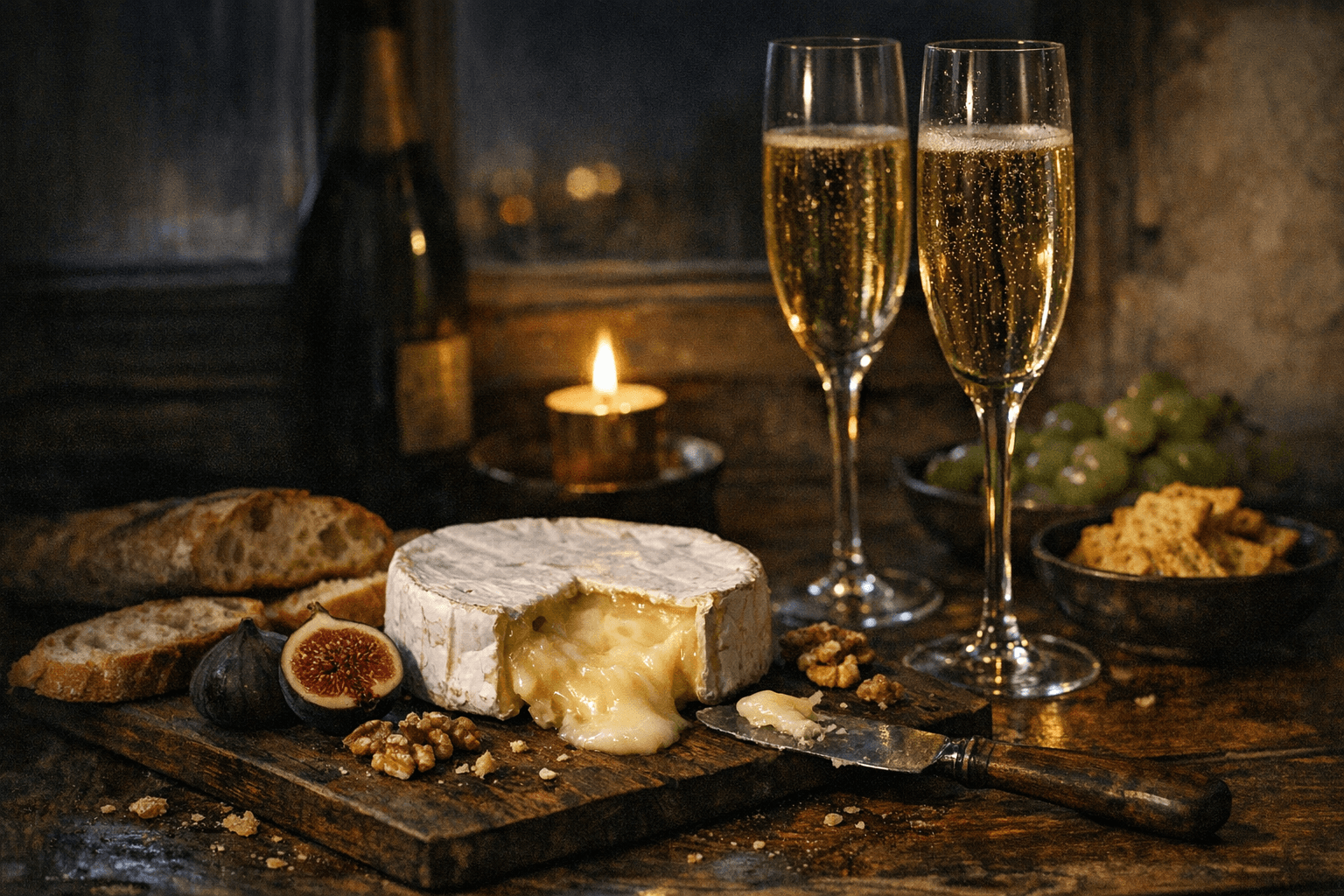
There is no peer-reviewed evidence that 11 PM is the optimal hour for Champagne and Brie pairing. There is also no evidence that it isn't. The Protocol proceeds accordingly.
At some point in the last decade, the wellness industry decided that decompression required a subscription, a wearable, and seventeen grams of magnesium glycinate dissolved in something described as 'moon water.' The 11 PM Champagne and Brie Protocol disagrees. It disagrees quietly, with good stemware, in a dim room, with no notifications and a wedge of Brie de Meaux resting at cool room temperature on a small board that represents, legally and spiritually, the hard boundary between your day and your night. This is not a clinical intervention. It is not melatonin. It is, however, the most coherent champagne and brie pairing you will execute after 10:45 PM, and that is enough.
Defining the Appellation of Emotional Exhaustion
Champagne originates from a precisely defined appellation in northeastern France — 34,200 hectares, 319 villages, three administrative regions, five departments, and an elaborate legal architecture that took centuries to negotiate. Your workday, by contrast, has no defined borders. It expands into dinner, into the couch, into the ambient hum of a phone face-up on the nightstand. The Protocol finds this asymmetry instructive.
The Champagne appellation is 0.5% of the world's vineyard area and accounts for 31% of global sparkling wine value. It punches, in other words, considerably above its weight — which is exactly the disposition you are attempting to adopt at 11 PM. For Protocol purposes, a Brut non-vintage is the standard-issue prescription: dry enough to cut through the Brie's cream, structured enough to feel intentional, available enough that you are not saving it for an occasion that will never feel sufficiently occasional. Those who find the standard Brut NV insufficiently austere may consider a Blanc de Blancs — a Chardonnay-dominant expression with a sharper, citrus-forward profile that brings additional precision to the late-night champagne and brie pairing without requiring any further justification. The Protocol approves both. It does not rank them.
The Brie Clause: AOP Status and the Board as Boundary
Not all Brie is Brie in the protected sense. 'Brie' has become a style designation, applied broadly and internationally to soft-ripened cow's-milk cheeses with a white Penicillium candidum rind. The Protocol respects this reality and does not require you to source a wheel from the Île-de-France at 11 PM on a Tuesday. It does, however, recommend you know what you're working with. Brie de Meaux AOP is the larger, milder, more forgiving option — good for the Protocol's first several weeks. Brie de Melun AOP runs smaller, saltier, and more assertive, with a rind that means business. Consider it an advanced-level dispensation.
At a competition loosely associated with the Congress of Vienna in 1815, Brie was reportedly crowned 'the king of cheeses.' Historians note this with varying degrees of confidence. The Protocol notes it with complete confidence, because the alternative — conducting an evidentiary review at 11 PM — is precisely the behavior The Protocol exists to end. When the Brie is gone, the board is cleared, and the workday is legally over. This is the Brie Clause. It is non-negotiable.
What The Protocol Does Not Claim
In the interest of transparency that the broader wellness industry has historically declined to offer: Champagne is not melatonin. A narrative review published in PubMed found that while alcohol may reduce the time it takes to fall asleep, it disrupts sleep architecture, suppresses REM sleep, and increases sleep fragmentation later in the night. The review further concluded that wine's polyphenol and melatonin content does not appear at levels sufficient to establish meaningful sleep benefits. The Protocol is aware of this literature and remains unbothered by it, because The Protocol never claimed to be a sleep aid. It claimed to be a ritual. These are different categories.
Champagne does not reduce stress in any clinically demonstrated sense. The bubbles are not a digestive therapy — carbonation can cause belching and abdominal distension, neither of which enhances the ritual's ambiance. Brie before bed does not cause nightmares, a piece of folklore so persistent and so unverified that its survival constitutes a minor public health mystery. The Protocol's field-tested position: Champagne before bed is not a therapeutic act. It is a sensory one — something cold and precise and slightly celebratory, paired with the fat, the salt, and the texture that tells your nervous system the performance is over. The ritual is the behavioral cue. Dim the lights. Put the phone down. Define an endpoint.
The Champagne sector shipped 266.1 million bottles in 2025, generating approximately €5.7 billion in revenue. The United States received 26.5 million of those bottles — more than any other export market. Somewhere in that figure is your glass, or the one you are about to pour. The industry employs roughly 30,000 people directly and 15,000 more during harvest, across 16,460 growers, 120 cooperatives, and 410 houses, all organized around the proposition that sparkling wine from this particular corner of northeastern France is worth the considerable effort. The Protocol agrees. At 11 PM, with a proper wedge of Brie de Meaux and no remaining obligations, it is worth exactly that — considerable effort, deliberately applied, in the service of a pleasure that is complete in itself. Follow with water. Follow with dental hygiene. Follow with the radical act of going to bed.
* This article contains opinions, satire, and possibly correct information about wine and cheese. It is not medical advice.