Beneath Reims, a network of chalk galleries stretching some 250 kilometers holds more Champagne than the region ships in a year. The Romans dug the tunnels. Nobody asked them to stop.
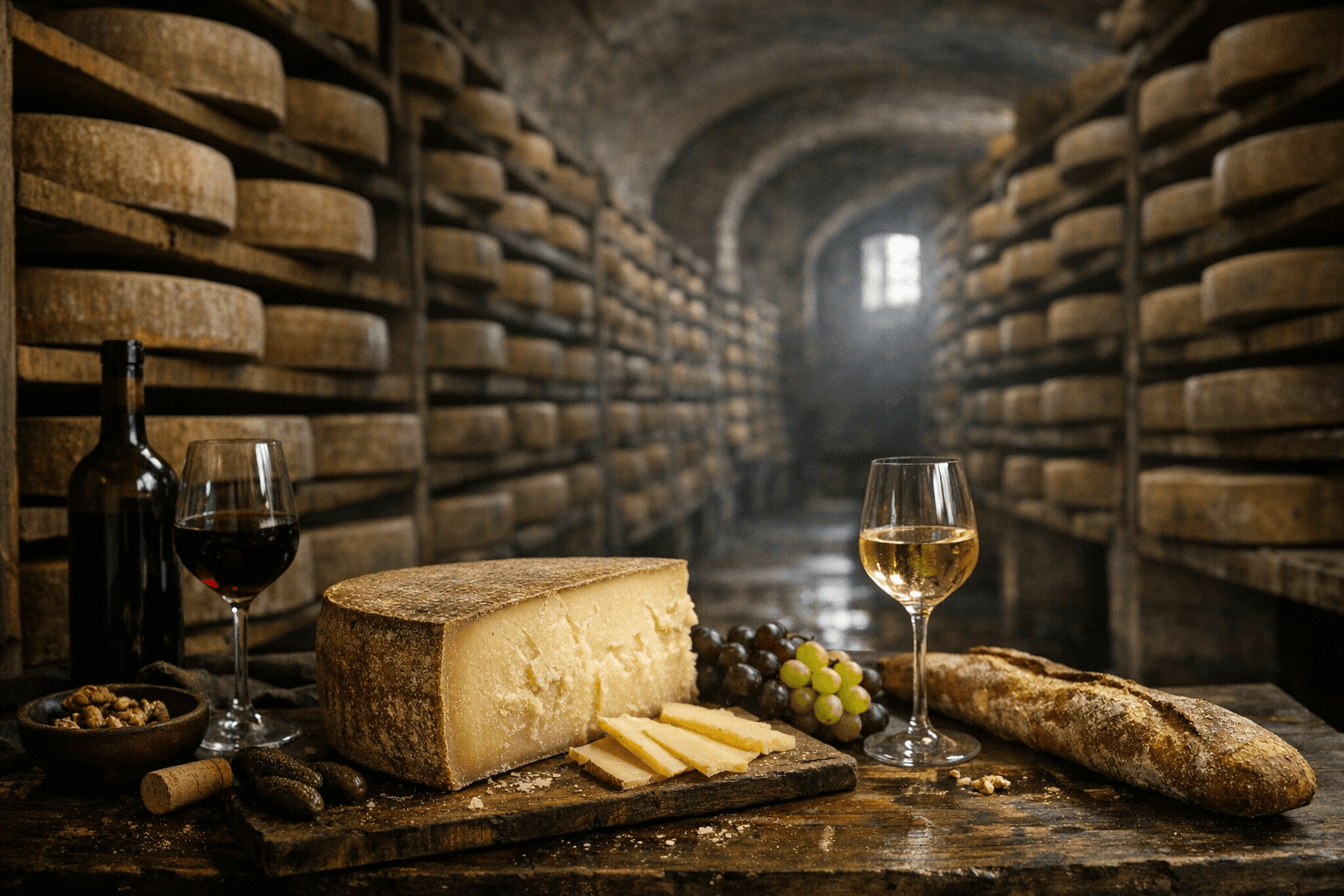
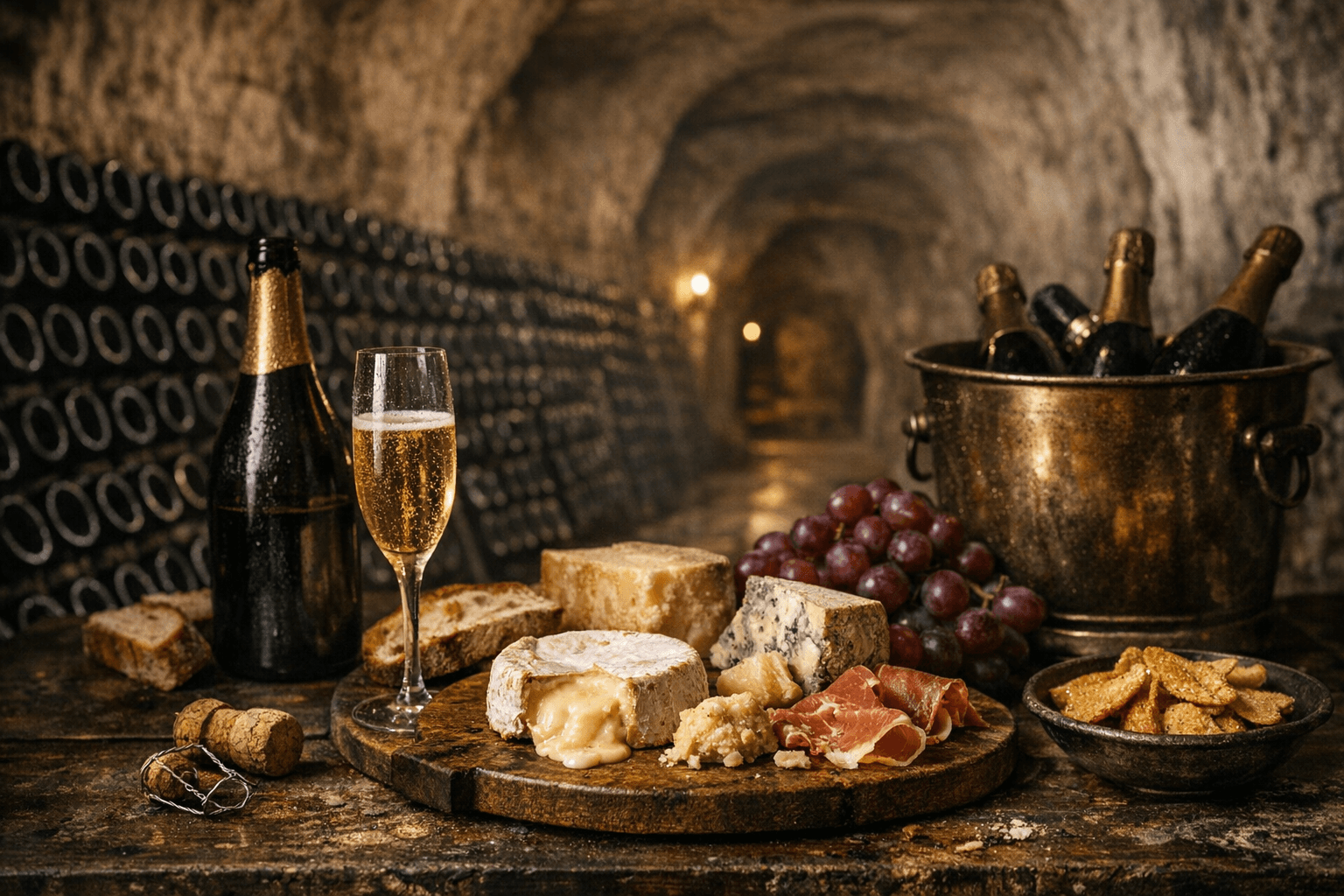
The staircase at Taittinger's cellars in Reims goes down about as far as you expect, and then keeps going. By the time you reach the main gallery, you are somewhere between 15 and 30 meters below the city, inside a chamber that the Romans started cutting around the 1st century CE, mostly for chalk they needed to build things above ground. They were not thinking about Champagne. Champagne did not exist. They were thinking about chalk. It is worth keeping that in mind when someone describes the caves as having been built for the wine, because nothing down here was built for the wine. The wine just showed up later and decided to stay, which, given that the galleries hold a reported 15 million bottles for Taittinger alone, appears to have been a reasonable call.
What the Romans Left Behind, and What the Traditional Method Aging Process Found There
The chalk quarries beneath Reims are commonly described as stretching approximately 250 kilometers in total, a figure that encompasses a fragmented network of galleries, tunnels, and chambers belonging to different producers, municipal authorities, and the occasional classified historical site. The Saint-Nicaise hill and its chalk cellars were inscribed as part of the UNESCO World Heritage cultural landscape 'Champagne Hillsides, Houses and Cellars' in 2015 — not because it sounds ceremonial, though it does, but because it marks something real: this geometry existed before the Champagne houses, before the riddling racks, before the disgorgement lines.
Roman quarrying in the area supplied chalk for construction, fertilizer, tanning, and polishing — practical industries with nothing to do with secondary fermentation in bottle. The Champagne houses recognized, beginning in the 18th and 19th centuries, that these galleries maintained a stable temperature of roughly 10 to 12 degrees Celsius year-round, which is nearly exactly what slow, even aging on lees requires. The houses did not engineer that temperature. The geology did. The houses ran the electricity and built the racks.
The Number That Nobody Can Quite Pin Down
The figure of more than 200 million bottles stored in Champagne's underground cellars circulates widely, attributed to the combined network across Reims, Épernay, and surrounding areas. The Comité Champagne reported 266.1 million bottles shipped in its most recently confirmed annual data, with roughly 56.5 percent exported. So the underground inventory represents nearly a full year of global shipments sitting in the dark at 11 degrees — a genuinely strange thing to consider while standing in a tunnel that a Roman quarryman carved with hand tools two thousand years ago.
Pommery's galleries are reported to extend approximately 18 kilometers. Moët and Chandon's cellars in Épernay are frequently cited at 28 kilometers and 90 million bottles, though these figures have not been independently confirmed by the house, which in Champagne is a category of information unto itself. What is clear is that the scale is real, the fragmentation is real, and the single tidy number — 200 million — is a reasonable approximation of something that does not have a single ledger. There is no one room. There is no one house. There is a region, and beneath it, a considerable amount of chalk, and inside that chalk, a considerable amount of wine.
What a Reims Underground Cellars Tour Actually Feels Like
The quiet in the galleries is genuine. Sound behaves differently when chalk absorbs it. The temperature is constant enough that your jacket becomes necessary about halfway down the staircase — not because it is dramatically cold but because 11 degrees is 11 degrees regardless of what July is doing above you. The bottles on the racks are tilted neck-down in the traditional pupitre position, angled so that lees consolidate toward the crown cap before disgorgement. A riddler can manage 50,000 bottles daily by hand, rotating each an eighth of a turn per day over the course of weeks — a standard professional benchmark in traditional-method Champagne production that sounds impossible until you watch someone do it. Both Taittinger and Pommery offer public cellar tours that include this context on-site, and the Taittinger visit ends with a tasting in a well-lit room above ground, which is the correct sequencing.
None of this is mystical. The caves are an active industrial environment. Workers move through them. Forklifts operate in the wider passages. The chalk walls that look ancient — because they are ancient — also have electrical conduit running along them and temperature monitoring equipment at intervals. What makes the cellars remarkable is not atmosphere but outcome: a geological accident of Cretaceous chalk and Roman quarrying created the precise conditions that a luxury sparkling wine industry would later require, and the industry simply moved in. That is either very good planning or very good luck, and since the Romans were not planning for Champagne, the answer is luck. Extraordinarily well-maintained luck.
When you come back up the stairs at Taittinger, you are offered a glass in a room with good light and appropriate stemware, which is the correct way to end a descent into chalk. The wine — a non-vintage Brut, in the visit recounted here — has spent a minimum of three years on lees in those galleries, longer than the legal minimum and shorter than some of the prestige cuvées aging deeper in the same tunnels. It is made from Chardonnay and Pinot Noir sourced across 34,200 hectares of appellation spread across 319 villages, unified by secondary fermentation and time and a temperature the chalk has been maintaining since before there was a Champagne to maintain it for. The Aube department sits at the southern edge of that appellation and produces Chaource — a cow's-milk cheese with a soft, pillowy bloomy rind, a lactic tang that firms toward the core as it ages, and enough bright acidity to hold its own against the bubbles without either component flinching. If you want to understand why regional pairing logic works, Chaource and Champagne are a reasonable place to start. Or you can drink the wine without the cheese and think about Romans digging in the dark. Both are reasonable choices.
* This article contains opinions, satire, and possibly correct information about wine and cheese. It is not medical advice.