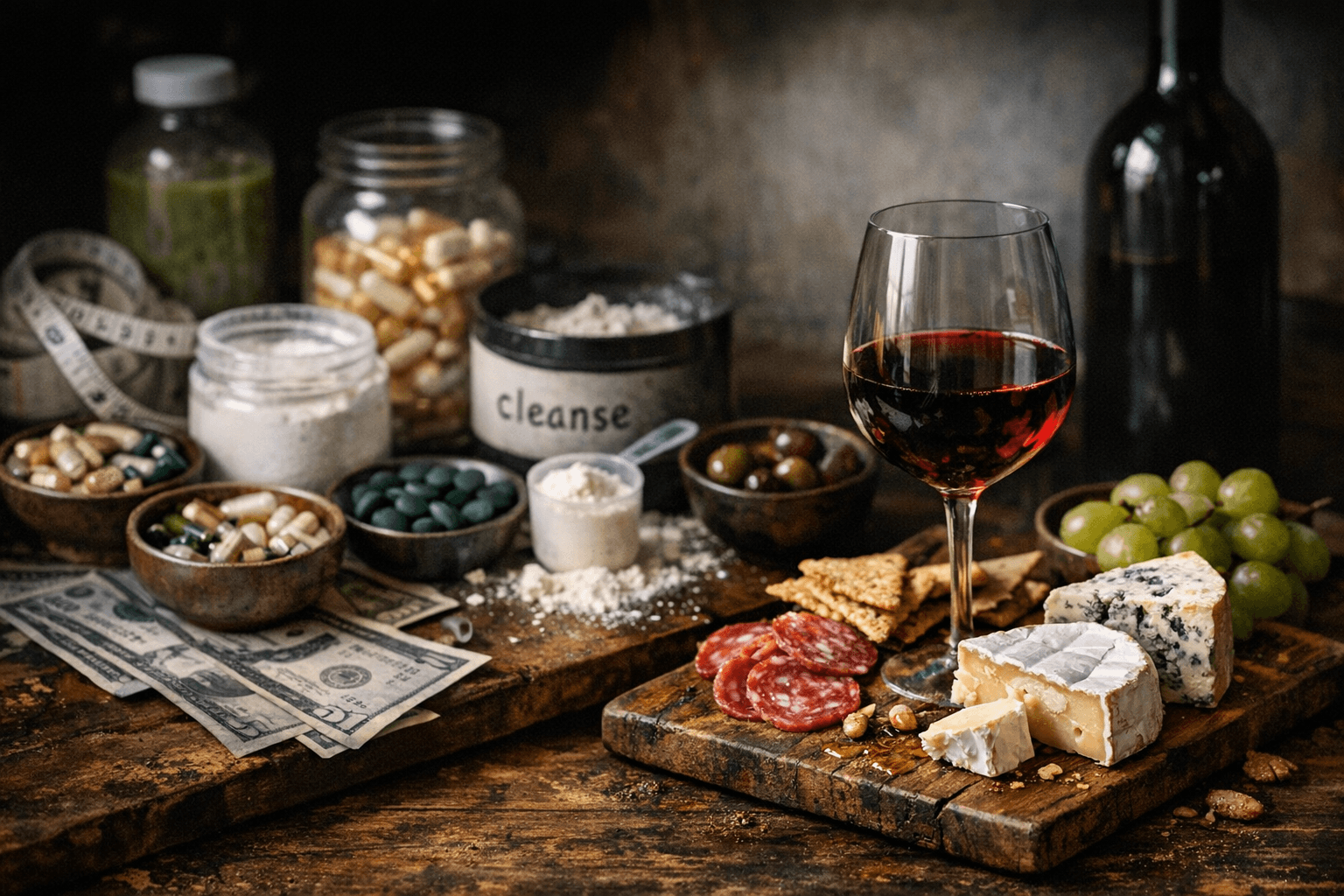
The global wellness industry has manufactured a perfect economic engine: first create the guilt, then sell the cure. Meanwhile, the French have been doing Tuesday night dinners for centuries without a subscription model.
The global wellness economy hit $6.8 trillion in 2024, which means it's now worth 60% of all medical spending worldwide. That's not a typo. An industry built on the premise that you're fundamentally broken has convinced the world to spend more on feeling bad about themselves than most countries' entire GDP. The beauty of this system isn't just its size—it's the elegant simplicity of its business model: first manufacture the guilt, then sell the cure. Meanwhile, somewhere in France, someone is having wine with dinner and not tracking the antioxidants.
The Revenue Model of Self-Loathing
Personal care and beauty leads this guilt parade at $1.3 trillion, because nothing says wellness like convincing people their natural state requires immediate correction. Wellness tourism follows at $830 billion—because apparently your regular vacation wasn't inadequate enough until you added juice fasting in Costa Rica. The spa sector alone commands $157 billion, which is roughly the GDP of Ukraine, for the privilege of having strangers tell you to breathe differently.
North Americans lead the charge, spending $5,768 per capita annually on wellness. That's more than most people spend on actual food, which feels appropriate given how much of the wellness industry revolves around not eating it. This spending paradox would baffle a culture that considers a proper meal a form of medicine, but then again, the French never needed to monetize their relationship with Camembert.
The Stagnation Paradox
Here's where the data gets interesting: workplace wellness spending actually dropped 1.5% in 2024. After decades of mandatory meditation apps and office yoga sessions, corporate America is quietly admitting these programs don't work. Yet the industry projects growth to $9.8 trillion by 2029, a 7.6% annual increase that assumes we'll become exponentially more dissatisfied with ourselves each year.
This disconnect reveals the genius of the guilt machine. Workplace wellness fails because you can't manufacture genuine wellbeing through corporate mandates. But personal wellness spending surges because individual guilt is infinitely renewable. Every failed cleanse creates a customer for the next one. It's a business model that would seem absurd to anyone who's ever watched a French person enjoy a three-hour lunch without once consulting a nutrition app.
The Subscription Model of Inadequacy
Mental wellness alone grew 12.4% annually, which sounds progressive until you realize it's largely apps designed to remind you how mindful you're not being. The wellness real estate sector exploded 19.5% annually—because regular homes apparently lack the spiritual infrastructure for proper self-improvement. Meditation studios, wellness centers, and optimization pods are sprouting like expensive mushrooms, each promising the inner peace that supposedly can't be achieved on your regular couch.
The industry has perfected what economists might call 'planned obsolescence of self-esteem.' Every product promises to be the last one you'll need, while being specifically designed to ensure you'll need the next one. It's a subscription model where the product is your own dissatisfaction, and the subscription automatically renews every time you look in a mirror. This approach stands in sharp contrast to cultures that view pleasure as a baseline human right rather than a productivity metric.
The French Exception
The French paradox isn't just about red wine and cheese protecting against heart disease—it's about a culture that never signed up for the guilt subscription service. They spend significantly less per capita on wellness products while maintaining better health outcomes and, crucially, better relationships with food and wine. This isn't because they're genetically superior; it's because they never bought into the premise that enjoyment requires optimization.
When you normalize pleasure instead of pathologizing it, something remarkable happens: you don't need a $157 billion spa industry to teach you how to relax. You don't need wellness tourism when your regular Tuesday includes wine that isn't measured by resveratrol content but by whether it pairs well with conversation. The French approach to food and drink isn't anti-wellness—it's pre-wellness, from a time when satisfaction didn't require a business plan.
The forecast to $9.8 trillion by 2029 isn't just ambitious—it's a roadmap for manufacturing inadequacy at industrial scale. But here's what the wellness industrial complex consistently misses: actual wellbeing isn't a product you can purchase or a state you can optimize into. It's the radical act of being satisfied with enough. Which, coincidentally, is terrible for quarterly earnings but excellent for Tuesday night dinners that don't require pre-authorization from your wellness app.
* This article contains opinions, satire, and possibly correct information about wine and cheese. It is not medical advice.