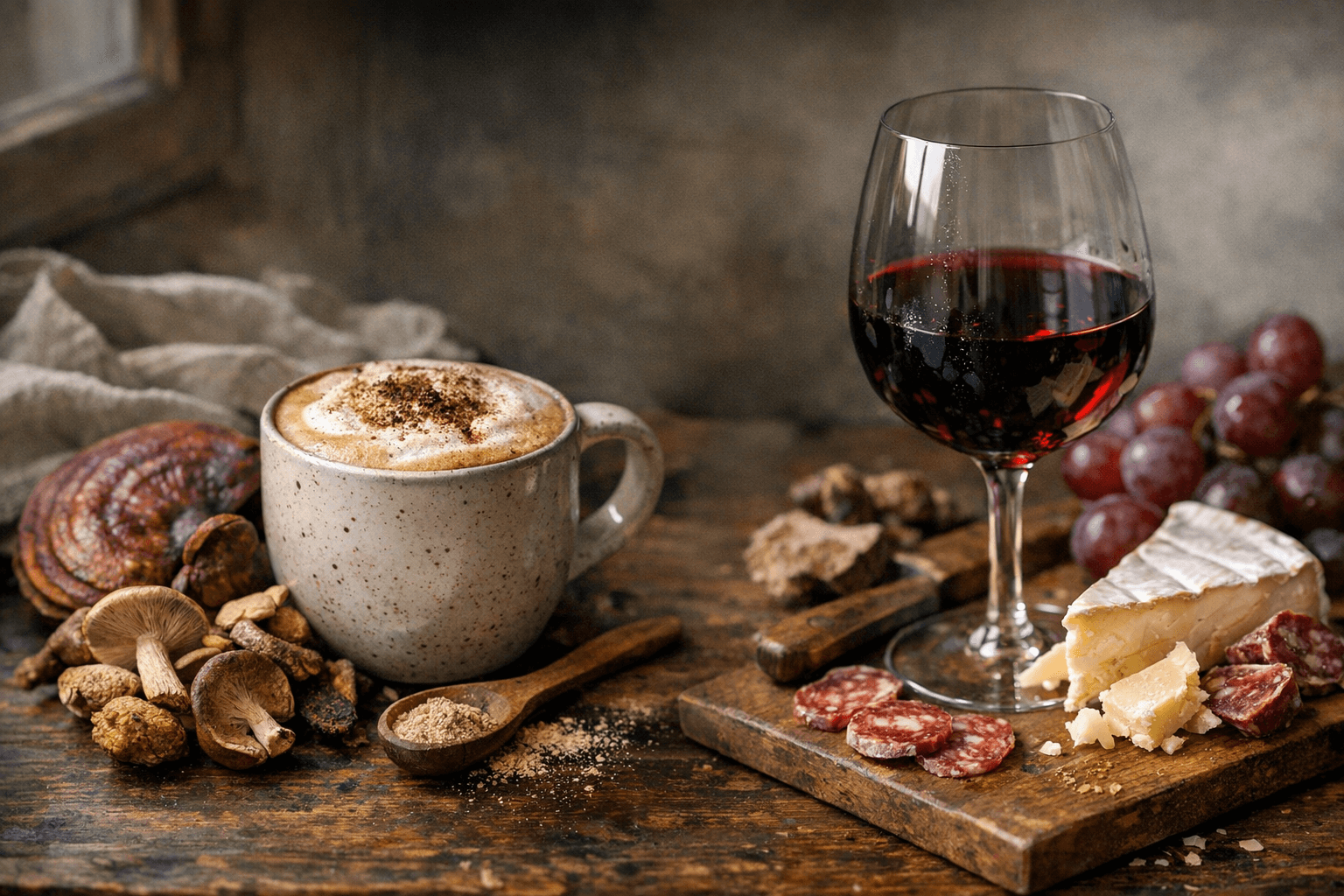
Both promise to fix your brain, calm your nervous system, and justify the price. One has human clinical trial data. The other has very compelling packaging and a lot of mice.
At some point in the last three years, an $8 latte made with Lion's Mane, Reishi, and Cordyceps became the responsible choice, and a $14 glass of Burgundy became the thing you have to explain to your wellness-forward friends. This is worth examining. Not because one is obviously correct — but because both sides are making health claims, and only one of them is being asked to prove it. A glass of Côte de Nuits Pinot Noir from Domaine Rossignol-Trapet's Gevrey-Chambertin does not come with an Instagram post about cortisol. The mushroom latte does. So we looked at the actual research, applied the same standard to both, and tried to figure out what you are actually buying for your money.
What the Mushroom Is Actually Doing In There
Adaptogenic mushrooms — the Lion's Mane, Reishi, and Cordyceps that appear most often in your $8 latte — operate primarily through beta-glucans and polysaccharides. These compounds modulate the HPA axis, which governs your cortisol response, and reduce oxidative stress through documented antioxidant activity. That mechanism is real. A 2021 review published in the International Journal of Medicinal Mushrooms confirmed broad pharmacological activity including immunomodulation and neuroprotection. A separate human trial found that a mushroom blend supplement significantly reduced anxiety, depression, and fatigue while improving sleep quality with no meaningful adverse effects.
The problem is not the mechanism. The problem is the leap from mechanism to marketing claim. Lion's Mane — the one most frequently credited with making you smarter — does show genuine evidence for memory and cognition improvement, according to a Medichecks nutrition analysis of available trials. But that evidence is strongest in adults over 50 taking at least 3 grams per day. If you are 28 and drinking one teaspoon of Lion's Mane powder dissolved in oat milk, the cognitive benefits are, per the same review, less noticeable. This is a polite way of saying the data does not support the claim at your dose, at your age. Reishi shows antioxidant effects that protect brain cells from beta-amyloid toxicity in Alzheimer's models and preserve dopamine neurons in Parkinson's models. Those are mouse models. Not a single human clinical trial has confirmed disease reversal or prevention from Reishi supplementation. Chaga has no direct evidence that it reduces anxiety or improves mood at all. It may reduce plaque associated with Alzheimer's in animal studies, which is not nothing — but it is also not what the latte menu implies.
What the Burgundy Is Actually Doing In There
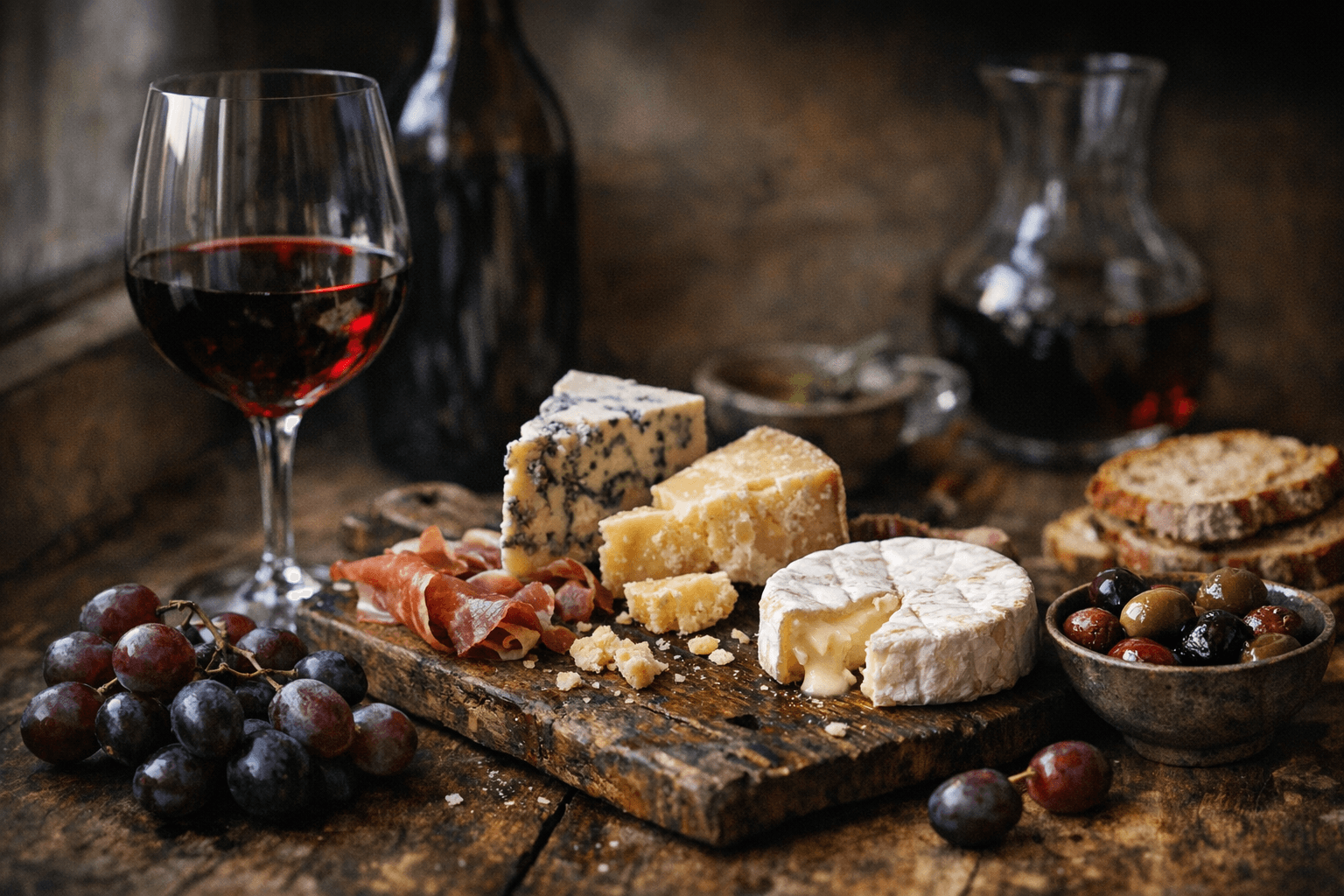
A glass of red Burgundy — specifically a Pinot Noir from the Côte de Nuits or Côte de Beaune, the two subregions that account for the best-known red appellations in France — delivers resveratrol and a broader polyphenol profile with documented cardioprotective and anti-inflammatory effects in human studies. Not mouse studies. Human ones. The resveratrol and polyphenol research behind red wine, summarized in multiple peer-reviewed cardiovascular reviews, shows measurable reduction in LDL oxidation and inflammatory markers at moderate consumption levels. One glass. The Côte de Nuits, home to appellations like Vosne-Romanée and Gevrey-Chambertin, produces Pinot Noir at yields as low as 10 to 15 hectoliters per hectare — meaning the fruit concentration, and by extension the polyphenol density, is genuinely high compared to higher-yield regions.
The honest caveat is the same one that applies to the mushrooms: dose dependency matters. One glass of Burgundy sits in a range where the human evidence is favorable. Four glasses is a different study with different outcomes. The wine industry has historically been less forthcoming about the dose curve than it should be, and calling polyphenols a reason to order a second bottle is about as scientifically honest as calling Chaga an anxiety cure. Burgundy's compounds reduce risk factors for cardiovascular disease. They do not reverse established disease, and no reputable cardiologist is prescribing Pommard in place of a statin. But the human evidence at moderate doses is substantially stronger than anything currently available for adaptogenic mushrooms in a wellness latte format.
The Actual Comparison, Applied Fairly
Here is what the evidence actually supports, applied to both products at the price point you are paying. The mushroom latte has a plausible mechanism, emerging human trial support for stress and fatigue reduction, and genuine neuroprotective data that is almost entirely confined to animal models when it comes to serious cognitive conditions. It also carries a documented side effect profile — digestive upset, headaches, rash, and potential allergic reactions are confirmed, and these supplements are contraindicated during pregnancy, breastfeeding, and prior to surgery. The Burgundy has stronger human evidence for its primary health claims, a well-characterized dose-response curve, and a side effect profile that is equally well-characterized and widely ignored.
The meaningful difference is not which one is good for you. It is which one is being marketed with more scientific confidence than the evidence warrants. A producer like Louis Jadot does not put 'clinically proven to reduce cortisol' on the back label of their Beaune Grèves. The mushroom latte almost certainly says something in that neighborhood. When a product's label is running ahead of its clinical trial data, that gap is not a reason to distrust the underlying ingredient. It is a reason to read the actual studies rather than the marketing copy.
The most defensible conclusion from the available literature is that a glass of Pinot Noir from Burgundy has stronger human evidence for its claimed benefits than an $8 adaptogenic mushroom latte, and the mushroom latte has better branding. That is not a verdict against mushrooms — the research on stress adaptation and sleep quality is genuinely promising, and a full-dose Lion's Mane protocol may well prove meaningful for cognitive health in aging populations. But promising is not proven, and the wellness industry has a long history of charging a premium for the story before the science arrives. The Burgundy has the science. It just also has the sense not to put it on the label.
* This article contains opinions, satire, and possibly correct information about wine and cheese. It is not medical advice.