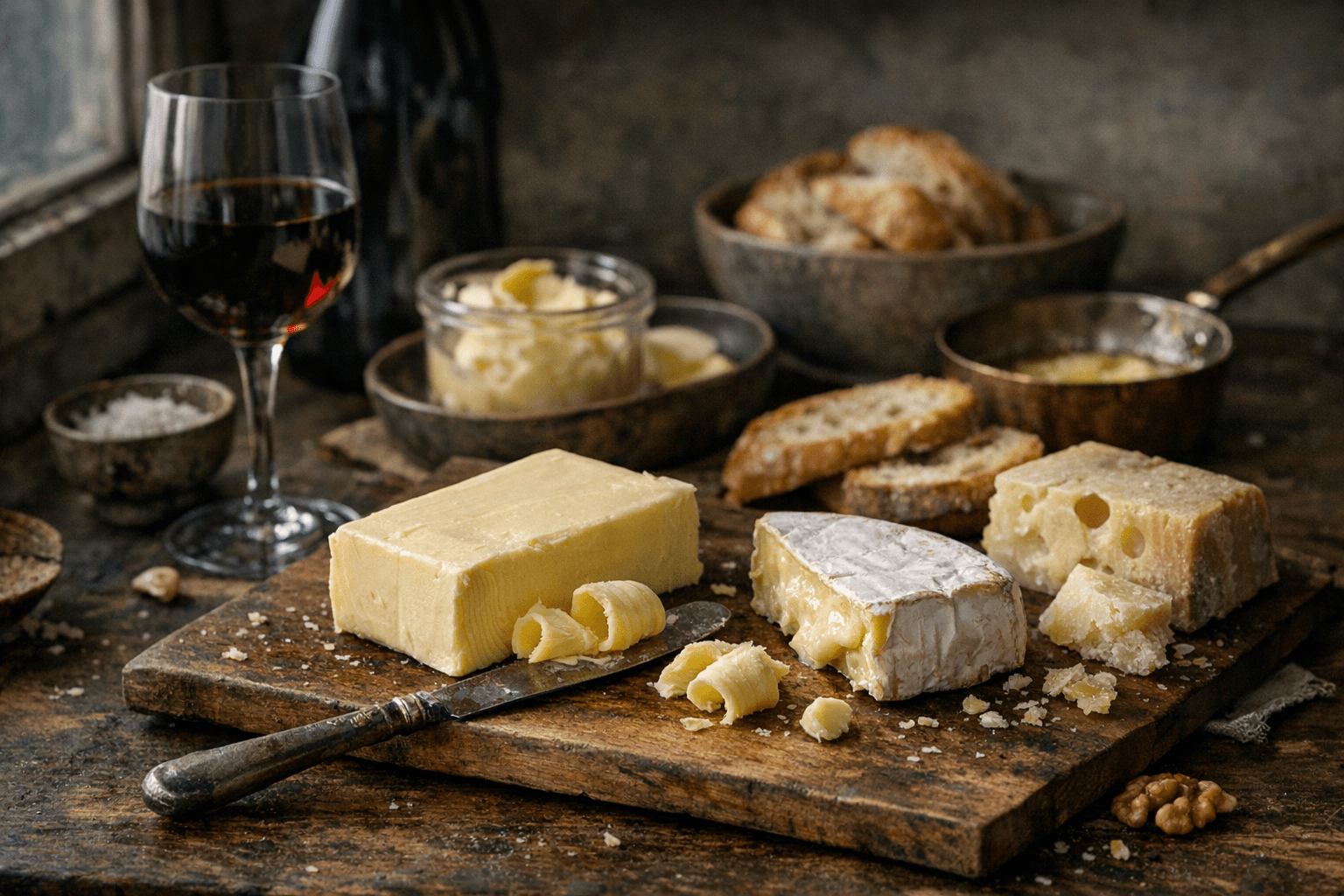
For fifty years, saturated fat was nutrition's clear villain. Then researchers started looking more carefully at what people ate instead, and the story got considerably less tidy.
If you grew up in the last fifty years, the answer to whether saturated fat is bad for you arrived pre-packaged — literally, on the side of every low-fat product in the grocery store. You were told clearly, and often, and with the kind of confident repetition that makes a thing feel like physics rather than policy. Then, in 2020, a review published in the Journal of the American College of Cardiology — a publication not known for being casual about cardiovascular risk — concluded that recent meta-analyses of both randomized controlled trials and observational studies found no beneficial effects of reducing saturated fat intake on cardiovascular disease or total mortality. Some analyses found protective effects against stroke. The evidence underneath the original saturated fat dietary guidelines, it turned out, was considerably more conditional than the version that made it onto the packaging. The science just kept going after the labels were printed.
So Is Saturated Fat Bad for You? The Guideline That Outran Its Evidence
Somewhere around 1961, saturated fat became nutrition's designated bad guy, and the story was told with the kind of clean moral confidence that makes things easy to repeat. Keep it under ten percent of calories. The heart will thank you. A 2021 review published in Nutrients, titled 'Dietary Saturated Fats and Health: Are the U.S. Guidelines Too Strict?', argued that multiple systematic reviews do not support continuing to recommend that limit. A broader historical overview, 'A Short History of Saturated Fat: The Making and Unmaking of a Dietary Villain,' documented that more than twenty reviews and umbrella reviews over the last decade have concluded that saturated fat does not affect major cardiovascular outcomes in the straightforward way older guidelines implied. Twenty reviews is a lot of reviews. The narrative had, as these things sometimes do, outpaced the data underneath it.
The Replacement Problem Nobody Put on the Label
The JACC review makes a point that tends to get lost in the simplified version of the debate: what matters most is not whether you reduce saturated fat, but what you replace it with. When saturated fat is swapped for polyunsaturated fat — the kind found in olive oil, nuts, and fatty fish — the evidence leans more favorable for cardiovascular outcomes. When it is replaced by refined carbohydrates, which is largely what happened when the low-fat food industry scaled up in the 1980s and 1990s, the evidence is not favorable at all. The swap that occurred at population scale was not the one the research would have recommended.
A 2025 updated Cochrane systematic review found that reducing saturated fat may slightly lower some cardiovascular outcomes, but with little benefit for people already at low cardiovascular risk — and more meaningful benefit only in higher-risk groups when the replacement is polyunsaturated fat. A 2024 umbrella review in Frontiers in Public Health found a probable reduction in combined cardiovascular events when saturated fat intake was lowered in randomized trials. The picture is not that saturated fat is harmless. It is that the story is risk-stratified, replacement-dependent, and considerably more conditional than the original commandment suggested.
Why Comté Behaves Differently Than a Stick of Butter — and What That Means for Dairy Fat Cardiovascular Risk
The part of this story most relevant to anyone who takes cheese seriously is the food matrix argument — the scientific way of saying that a nutrient does not travel alone. Prospective studies reviewed in a paper published in Advances in Nutrition found that dairy consumption, despite contributing meaningful amounts of saturated fat, has frequently been associated with lower cardiovascular risk, not higher. A wheel of Comté from the Jura, aged eighteen months by Marcel Petite at Fort Saint-Antoine, is not nutritionally equivalent to the same grams of saturated fat measured out in a laboratory model. The calcium, protein, fermentation byproducts, and overall food structure change how the fat behaves in the body. Cheese and yogurt appear to behave differently than butter, which behaves differently than isolated saturated fat in a controlled feeding study. That is what the dairy fat cardiovascular risk literature is actually showing — not that dairy is a free pass, but that the food around the fat is doing real work.
The LDL question deserves a precise answer too. Saturated fat does raise LDL cholesterol — the JACC review is clear on this — and that is worth taking seriously, especially if you already carry elevated cardiovascular risk. Worth noting: the shift in LDL tends to be toward larger particles, which carry less cardiovascular risk than the smaller, denser variety considered more concerning clinically. So 'saturated fat raises LDL' and 'saturated fat causes heart disease' are not the same sentence. Anyone managing existing cardiovascular risk should have that conversation with their doctor, not their cheese board.
The French Paradox — the observation that France has historically had lower rates of cardiovascular disease than expected given its dairy and wine consumption — is a narrative device, not a controlled experiment, and it should be used as one. What it represents is a useful prompt to ask better questions: about food culture, about what foods accompany and replace each other, about whether a population eating Roquefort alongside a glass of Cahors Malbec is doing something metabolically different from one eating low-fat crackers with a diet soda. How that plays out across a whole food culture is exactly what the French Paradox files on this site are built around. The conclusion the research earns is narrow and specific: the evidence for a single, universal, population-wide saturated fat limit was weaker and more contested than the confidence with which it was delivered. For most people eating mostly whole foods — including good cheese — the more productive question is what they are eating instead.
* This article contains opinions, satire, and possibly correct information about wine and cheese. It is not medical advice.