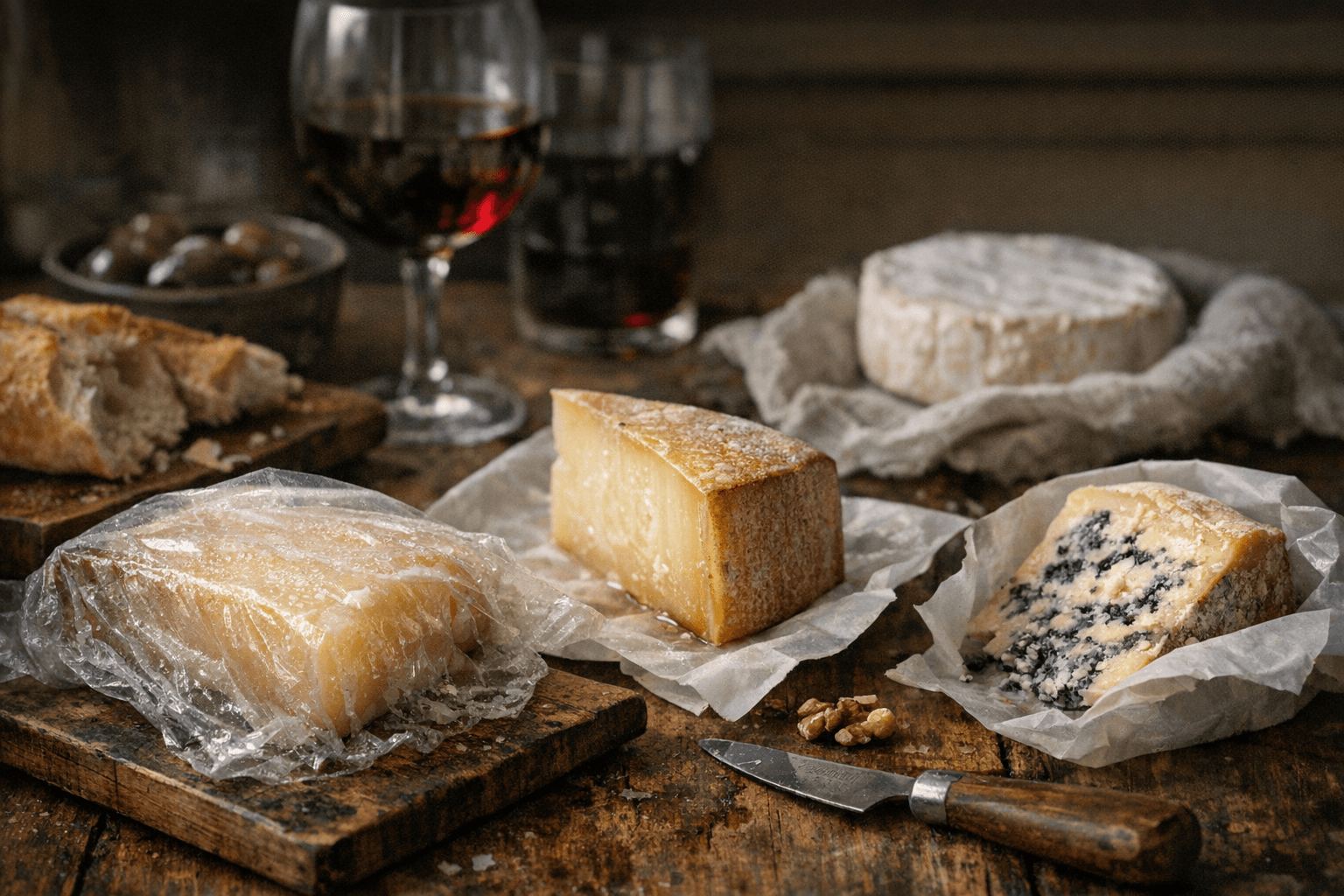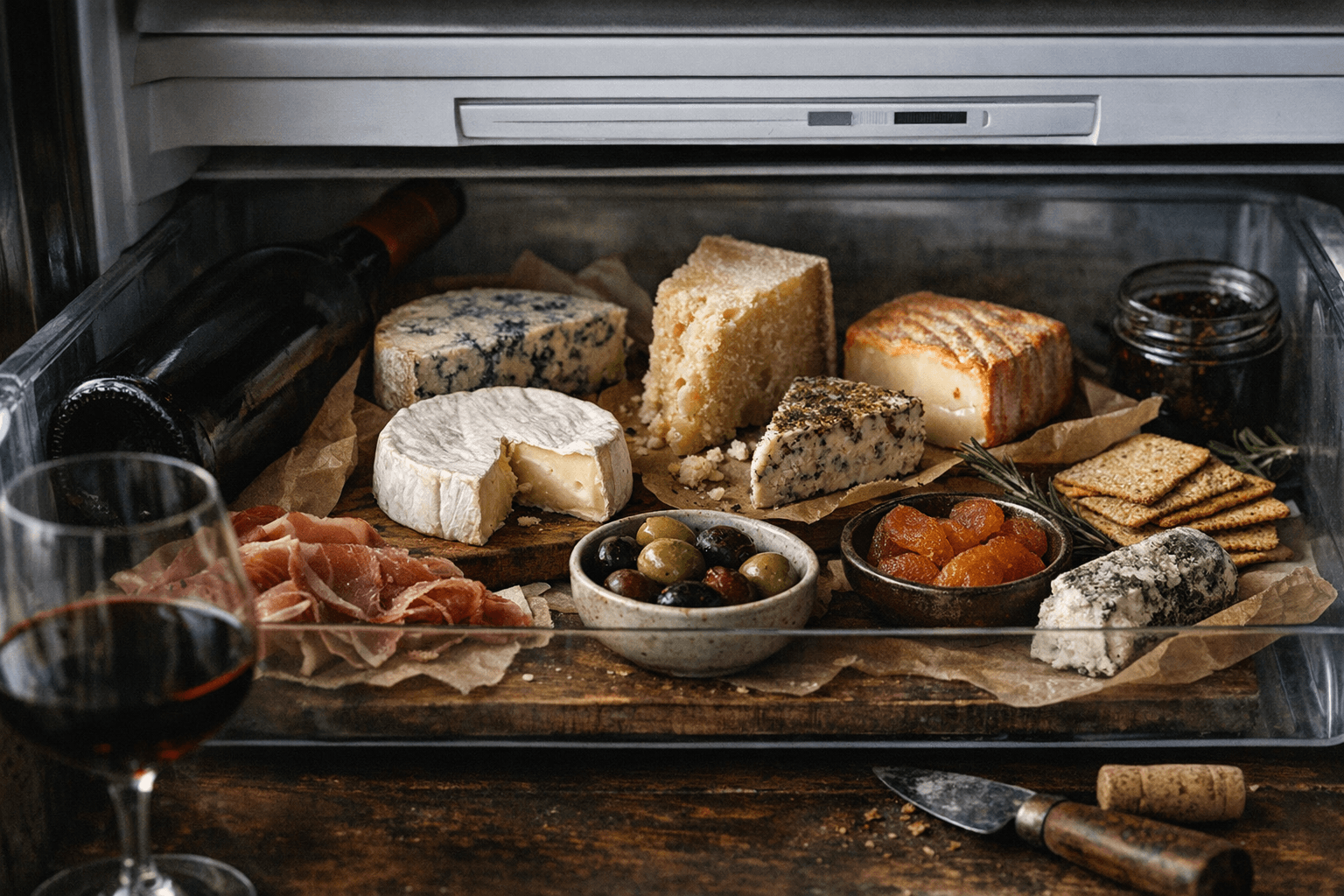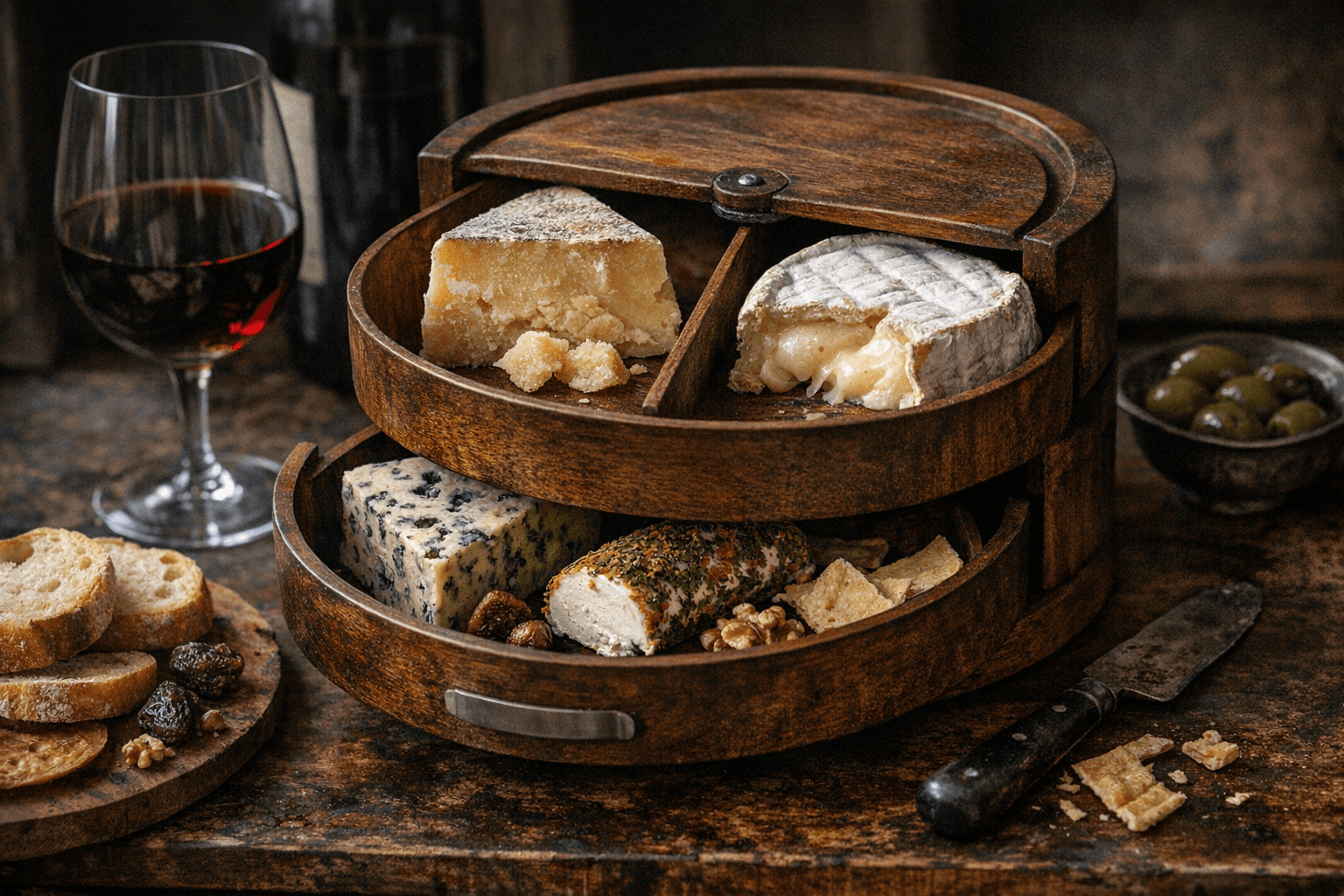
A three-cheese system — one hard, one soft, one wild card — means you always have a balanced board ready without buying six wedges for a dinner party that isn't happening. Here is how to run it.
At some point, most households arrive at the same cheese situation: a desiccated heel of aged Gouda from two months ago, a Brie that was going to be for a gathering, and something blue that nobody can fully account for. This is not a cheese drawer. This is a cheese archive, and it is not serving anyone. The fix is not more cheese knowledge or better intentions. It is a rotation system with exactly three positions — one hard, one soft, one wild card — maintained small, cycled regularly, and kept at or below 40 degrees Fahrenheit per FDA guidance. That is the whole system. Everything else is commentary.
Position One: The Incumbent (Hard Cheese)
The hard cheese is the durable anchor of the drawer. A wedge of Parmigiano Reggiano from the Emilia-Romagna region, an aged Comté from the Jura, a Pecorino Romano, or a good aged Cheddar from a producer like Cabot or Keen's — any of these will hold for weeks when tightly rewrapped after each use. The Food Marketing Institute's consumer food-storage guide confirms that Parmesan and Romano are among the longer-lasting refrigerator cheeses, which is a designation those cheeses have earned through sheer moisture loss.
The rotation rule for this position is simple: buy a small wedge, not a block the size of a paperback novel, and replace it when what remains is too dry to plate with any dignity. The hard cheese is not a pantry staple you stockpile. It is an officer with a fixed term. When it's done, it's done, and you bring in its replacement fresh.
Position Two: The High-Maintenance Minister (Soft Cheese)
The soft cheese is the most time-sensitive appointment in the drawer, and it knows it. A ripe Brie de Meaux, a Camembert de Normandie, a small log of chèvre, or a ball of fresh mozzarella all serve this position well, but none of them are going to wait for you. FDA guidance is straightforward: refrigerate perishable dairy within two hours of purchase, keep it at or below 40 degrees Fahrenheit, and follow the package's use-by date without optimism. Brie and Camembert are explicitly more perishable than their harder counterparts, and Listeria — which can grow even at refrigerator temperatures, albeit slowly — is a legitimate reason to treat soft cheese as the cheese you eat first, not the one you save for a special occasion.
Buy the smallest practical format available. A 125-gram Camembert wheel is the right size for the drawer. A 500-gram log of chèvre is a commitment. High-risk individuals — including pregnant people — should confirm that soft cheeses in this position are made from pasteurized milk, per FDA's ready-to-eat foods guidance. If the label does not say pasteurized, that is relevant information. The soft cheese position turns over fast by design, which is not a flaw. It is the point.
Position Three: The Wild Card (Earn Reappointment or Leave)
The third position exists to prevent the drawer from becoming two reliable cheeses and a vague intention. It is filled by whatever is unfamiliar, seasonal, or strongly flavored — a Roquefort from the caves of Combalou in southern France, a washed-rind Époisses de Bourgogne, a smoked sheep's-milk cheese, a Manchego aged beyond the standard curado range, or a Stilton from one of the licensed dairies in Leicestershire. The selection criterion is contrast: texture, intensity, and milk type relative to the other two positions. Three mild cow's-milk cheeses of varying firmness is not a rotation. It is a theme.
The wild card earns reappointment by being interesting enough to repeat. If the washed-rind cheese sat untouched for ten days because nobody could get past the smell, that is data. It does not come back next cycle. This is not a failure — it is the system functioning correctly. Regarding mold on the wild card: the USDA's guidance from 'Molds on Food: Are They Dangerous?' draws a clear line. For hard cheese, cut at least one inch around and below visible mold and the remainder is generally safe to use. For soft cheese — including Brie, Camembert, and fresh styles — mold that is not part of the intended manufacturing process means the cheese is discarded. Full stop. Roquefort's blue veining is intentional. An unexpected fuzzy patch on your chèvre is not.
The three-position system is not a medical prescription, a nutritional protocol, or a lifestyle philosophy. It is a behavioral design for a refrigerator drawer. It encourages smaller purchases, visible rotation, and less forgotten cheese — which, if you have ever thrown away a cheese you do not remember buying, is a more meaningful outcome than it sounds. Keep the drawer cold, eat the soft cheese first, give the wild card one honest shot, and let the hard cheese anchor everything until it has nothing left to offer. That is the whole thing. It works because it is small enough to actually follow, and because a Comté and a glass of Jura white on a Tuesday is a perfectly reasonable life.
* This article contains opinions, satire, and possibly correct information about wine and cheese. It is not medical advice.